The morning breeze of the highlands at this time is cool, sharp, and carries the scent of the forest from the ground, which is still damp. It is 06:15 hours when the sun starts to come out from behind the hills of Eastern Ghats, which are the hills of emerald, and it starts to throw long shadows over the valley. As you get to the top of the grassy ridge you get the sound of train wheels hitting tracks at regular intervals and a faint horn sound getting into the forest. Then, you see a long freight train coming out of the mountain tunnel which was cut from the mountain rock and moving over a bridge made of concrete that spans over the mountain stream which was the reason for the bridge.
You are not in the Swiss Alps or the badlands of the highland Sri Lanka. You are witnessing the magnificent Maliguda Tunnel and Bridge complex of the Southern Odisha region. As a railfan and an adventurer, I can tell you that visiting this remote mountain valley is an experience of a lifetime. I have been spending my mornings exploring the highland valleys and ghat roads and seeing a train running through this ancient landscape is something special.
Location and How to Reach Maliguda Tunnel Bridge?
Figuring out the best way to plan your visit to the area can be made easy through what comes next options as soon as you are at the Read Koraput Travel Guide:
By Train: The nearest major railway station is Koraput Junction (KRPU) around 30 Kms from the destination. The popular Kirandul-Visakhapatnam Passenger and Vistadome bound Visakhapatnam-Araku Express are both memorable railway adventures on KK line and are among the top railway journeys one could take. Alternatively, you could get off at Jeypore or Jarati on the way from either of these train routes and hire a taxi or auto-rickshaw (~800-1200) to the nearest viewpoint.
By Road: The national highway NH – 26 connecting Koraput and Jeypore is very close to the bridge which makes this spot very conveniently reachable by road as well. A rented private car or renting a scooter ( Rs. 500/day) from Koraput town would get you around 45 minutes to the view point.
By Air: The closest domestic airport is Vishakhapatnam (VTZ) about 210 Kms away from the railway complex having a scenic drive up of over 5 hours to Araku Valley ghat road.
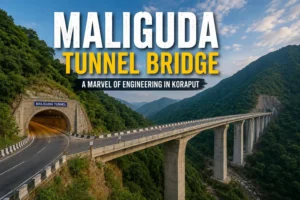
Engineering Highlights (length, depth, gradient, curves)
While analyzing the Engineering Highlights (length, depth, gradient, curves), you feel proud to see such an achievement in an age when computer aided boring machines weren’t so prevalent.
Broad Gauge Feat: This tunnel used to be the highest broad gauge tunnel in the country at an altitude of approximately 870 meters above the sea level.
Dimensions: This single track tunnel is 484 meters long and cuts through granites of the adjoining hills.
The Soaring Viaduct: As the train emerges out of the tunnel it banks on to a curved and towering viaduct that has 13 concrete piers of large dimensions at a height of nearly 30 meters from the valley floor.
Gradient and Alignment: The track has a ruling gradient of 1 in 60 and curves in the form of S to negotiate the steep descent of the mountain range while carrying fully laden iron-ore freight trains of nearly 4,000 tons with ease.
History – The Japanese Collaboration and Kirandul-Kottavalasa Line
The History – The Japanese Collaboration and Kirandul-Kottavalasa Line reveals that India signed a contract with the Japanese government to build a track in order to transport the rich Bailadila iron-ore (in Chhattisgarh) down to Visakhapatnam for the first time after our independence.
A joint collaboration between the Japanese railways and the East Coast Railways resulted in the magnificent KK line (Kottavalasa-Kirandul) that was opened for traffic in 1966. This line meanders along the rugged escarpments, negotiates 58 tunnels and about 800+ bridges to form a remarkable and enduring symbol of human perseverance and international collaboration.
Best Spots and Timings to Watch the Train
Finding the Best Spots and Timings to Watch the Train will involve seeing the metal monsters from two completely different perspectives.
The Northern Ridge Viewpoint: You may choose to climb up a small gully behind the northern outcrop to get an unobstructed view of the train emerging out of the tunnel onto the viaduct.
The Valley Stream Level: You could alternatively go down the gully to the valley stream and look up to the concrete piers to see the monstrous 50 wagon freight train trundle by right above your head on to the bridge.
Ideal Timing to Capture the Train Traffic: Freight trains run through the region throughout the day. However, the best time to capture good photographs is in the early morning between 06:30 AM to 09:00 AM when the valley is aglow with the morning sunlight.
The Waterfall/Stream Beneath the Bridge
A walk along The Maliguda Waterfall/Stream Beneath the Bridge could be an excellent way to spend your afternoon. This mountain stream cascades down the rocky outcrops from the upper valley to form small natural pools of water exactly underneath the central span of the viaduct. These little falls become absolutely spectacular during the post-monsoon period contrasting greatly with the concrete blocks above. Sitting on a cool rocky ledge, you can dip your toes in the little pool and enjoy the cool mountain breeze and the melodious tunes of the birds.
Photography Tips
Some Practical Photography Tips:
- Lens range: Having a wide-angle and a telephoto zoom lens (16-35 as well as 79-290mm) with you will enable you to capture the entire scene and also to shoot the steam engine and its coaches emerging to the scene out of the darkness behind the tunnel.
- Shutter speed: Setting the shutter speed of the camera at 1/1000s will capture the speed of the train and give a clear and defined picture of the steel wheels.
- Drone Safety: If you plan to film the bridge together with a valley and the valley from the with the help of a camera drone then be careful not to fly too close near the high voltage traction lines running over the valley as otherwise electrocution might happen to you.
Is it safe to walk inside the train tunnel or onto the tracks of the bridge?
It is strictly prohibited to walk inside the tunnel or on to the tracks of the viaduct. The trains usually don’t have a fixed time-table as they carry freight. It is always a good idea to keep a safe distance and watch the mighty engine from an elevated grassy ridge or from the valley stream level at the base of the viaduct pillars.
Are there any food joints or restrooms available at the spot?
There aren’t any restaurants or restrooms at the viewpoint as the place is still rather remote and surrounded by tribal hamlets. It is always a good idea to carry with you enough drinking water, light snacks and other essential supplies from Koraput or Jeypore before visiting the spot.
What are the best months to visit the valley?
The winters (October-February) are the best time to see the valley as the mountain weather is comparatively pleasant. Plus, the surrounding hills offer great scenery with their greenery even during the peak of winter.