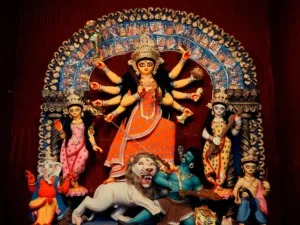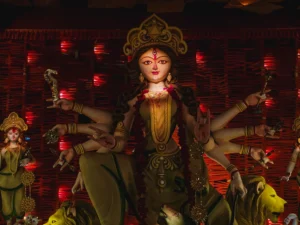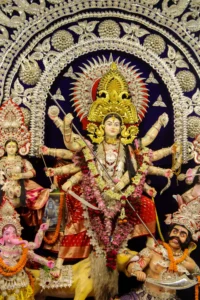
A bonedi bari puja is just a house puja, a family affair held in the ancestral home which has been around for hundreds of years. And the way to visit is totally different from visiting a barawari pandal. No theme, no installation art, no crowd through loudspeakers. Instead, you get a glimpse of the continuity of tradition: same idol form, same rites, perhaps even the same physical structure, all carried out by the same family for two, three, or maybe even four hundred years. This article explains the meaning of Bonedi bari puja, lists some important homes, and most importantly, gives tips on how to visit such houses in a respectful manner as this is more crucial here than in any other area of the pujo tourism.
What Is a Bonedi Bari Puja?
Bonedi literally means old aristocratic landed families who used to occupy zamindari (landholding) status or major wealth and power under Mughal or British era Bengal. Bonedi Durga Puja or barir pujo (household puja) was held for centuries before the community, public-organized model existed.Actually you are attending a private family ceremony which is ancient and predates even modern-day Kolkata – bearing the thought that not only are you a guest in someone’s home, also a visitor in someone’s family not merely a spectator of a show.
Barowari vs Bonedi Bari: What’s the Difference?
| Bonedi Bari | Barowari /
Sarbojanin |
|
| Organized by | One family | A community club/committee |
| Origin | Centuries old in many cases | Emerged later, as a collective alternative when ordinary people wanted a puja without a landed family’s wealth |
| Idol style | Almost always ekchala (all deities on one frame) | Increasingly standalone, elaborately staged idols |
| Theme/installation | None — same form | Often a new artistic theme |
| yearly | each year | |
| Atmosphere | Intimate, ritual-
focused, quiet |
Crowded,
festive, spectacledriven |
| Public access | Varies by family — some welcome
visitors, some don’t |
Fully open to all |
| Funding | Family wealth/trust | Public donations (chanda), sponsorships |
The 15 Bonedi Baris to Visit
Get in touch with each house by phone or in person and confirm the visiting policy, business hours, and any restrictions about taking pictures or photos beforehand, and double check before claiming things to be facts. The policies might change and families might get tired after welcoming the visitors, who have not been to this year.
A large number of visitors come to enjoy Durga Puja at Sabarna Roy Choudhury Bari Barisha the oldest Durga Puja in Kolkata recorded as begun in 1610 at the ek-chala Bari (ek-chala Bari means 6-pile house) of Lakshmikanta Gangopadhyay Roy Choudhury Majumdar and his wife Bhagawati Devi. The family continues to perform it on largely the same ekchala or the Durgabhaktitarangini text and the animal sacrifice practice was stopped. Later on, the family has separated their pujas into eight household ones – six household ones from Barisha and two others are at Birati and Nimta- Pathanpur.
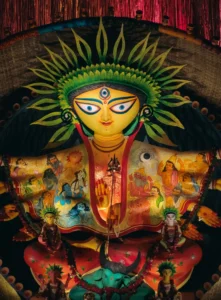
Sovabazar Rajbari
Built by Maharaja Nabakrishna Deb in 1757 soon after the fall of the Battle of Plassey. The early years witnessed the presence of Lord Clive and Warren Hastings. Two palaces built together hold separate pujas – one through an adopted son Gopimohan Deb and the other through a biological son, Raja Rajkrishna Deb of the Deb family. So, it’s recommended that your time should plan to witness both pujas rather than just one.
Haldar Bari, Bagbazar
This puja of the house has been celebrated every year from 1804.
Dutta Bari, Bagbazar
Another old and wellknown house puja, of the same Bagbazar area community, different from the Thanthania Dutta family puja.
Ghose Bami, Southern Avenue
This is one of the household puja of south kolkata heritage but it has been less known publicly.
Sil Bari, Colootola
The puja of this mercantile family household is very old and has the goodwill of the locals of Central Kolkata.
Mitra Bari, Bhawanipore
One the family pujas in Kolkata, South Kolkata, that is a totally separate and distinct one from Darjipara Mitra Bari.
Rani Rashmoni Bari, Janbazar
This residence is a place where Rani Rashmoni, an outstanding philanthropist, lived. She was one who inspired people for a religious activity when she founded a temple of Kali and so, through time, this house puja of Mitra became one of them also.
Thanthania Dutta Bari
Started by Dwarkanath Dutta in 1855, the puja is most of all known for worshiping the forms of Hara-Gauri and this way, their standard is not as usual Durga.
Chhatu Babu-Latu Babu Bari
A puja household of a mercantile family of North/Central Kolkata, that the brothers Chhatu and Latu have been very well known in the 19th century for.
Darjipara Mitra Bari
The Mitra family’s another home, in North Kolkata, that holds a unique set of rituals from the Mitra family in Bhowanipore.
Laha Bari, Thanthania
A family puja of a merchant household located in the Thanthania area that is well known for traditional and authentic presentations of the puja.
Khelat Ghosh Bari, Pathuriaghata
One of the grander houses of Pathuriaghata showing the wealth of 19th-century merchant families in the area.
Marble Palace (Mullick family)
One of Kolkata’s most famous heritage mansions, richly furnished European art and marble statues, besides housing Mullick family’s Durga Puja inside the building, unlike its other museum visitors, is known for!
Jorasanko Daw Bari (Shibkrishna Daw Bari)
In a neighborhood famous among North Kolkata merchant families as well as Tagore family’s Jorasanko Thakur Bari, a Jorasanko- area household puja is celebrated there by another prominent merchant family.
A One-Day Bonedi Bari Walking Trail
A realistic single-day route sticks to the North Kolkata cluster, since most of these houses sit within walking distance of each other around Bagbazar, Pathuriaghata, and Jorasanko:
| Time | Stop |
| 9:00 AM | Sovabazar Rajbari (both houses) |
| 10:30 AM | Haldar Bari, Bagbazar |
| 11:15 AM | Dutta Bari, Bagbazar |
| 12:30 PM | Khelat Ghosh Bari, Pathuriaghata |
| 1:30 PM | Break — lunch |
| Time | Stop |
| 3:00 PM | Jorasanko Daw Bari |
| 4:00 PM | Marble Palace |
| 5:30 PM | Thanthania Dutta Bari / Laha Bari |
Pair this with the North Kolkata pandal guide (Brief 07) if you want to combine bonedi bari visits with barowari pandal-hopping later the same evening — mornings for the households, evenings for the crowds.
Rituals You’ll See Here and Nowhere Else
- Kanakanjali, this is the offering ritual where coins or gold ornaments that symbolically represent wealth, are tied in a piece of cloth that is used in household pujas.
- Dhuno porano is a religious practice where a female member of the family carries dhunuchi (incense pots) either on her head or in her hand, performing an act of devotion. This is mainly carried out in a family courtyard, this way not on a public stage.
- Boron, an auspicious ritual conducted in the form of goddess welcome or saying goodbye, and here performed by the womenfolk of the household using vermilion, sweets and betel leaves.
- Sindoor khela in its original form of the house – married women apply vermilion on the image and to each other during Dashami as an intimate family tradition. This is unlike now a big public version in some barowari pujas that is common.
- Family-specific bhog, recipes and offering materials specific to every household, some are unchanged for generations.
- Kola bou, a banana-plant figurine bride that is bathed and dressed, and is placed alongside the goddess during Shashthi and is a part of bonedi bari and barowari pujas. But, mostly in home settings, its ritual procedure is more precisely executed.
- Thakur dalan, a structure of open columns and pavilion made mainly to hold the puja; this is considered the architectural center of a bonedi bary (house).
- Ek-chala idols with daker saj (silver-foil ornamentation)- These idols are all in one frame and were decorated originally by imported silver foil through mail order from Germany.
Visiting Etiquette
These are private homes, not museums or pandals. A few things to hold to plainly:
- Ask permission before taking photographs. Don’t suppose that your camera will be greeted with a smile simply because the courtyard is accessible from the street.
- Make sure your clothes cover you appropriately.
- Shoes are not allowed inside the thakur dalan.
- Don’t see this house as a show and this family as performers. You’re walking into a living, active ceremony at home, not watching a show.
Bonedi Bari Pujas Beyond Kolkata
Beyond the city walls, one can still find this bonedi bari culture. Murshidabad where the Nawabs of Bengal were stationed before, also hosts a lot of old zamindari pujas by the way. Bishnupur, a town famous for its terracotta temples, also has a family based pujas tradition that is connected to its royal families of yesteryears. Besides Rajbari pujas, the whole map of rural Bengal is strewn with numerous pujas held at the family level. Such pujas are generally less accessible and this way, are more genuine and in keeping with tradition, unlike the pujas in Kolkata that have a very public and pandal culture. Durga Puja, in general, was added to UNESCO’s Representative List of the Intangible Cultural Heritage of Humanity, in 2021. This accolade is partly based on exactly this tradition of the household pujas plus the public pandal culture.
Frequently Asked Questions
What is a bonedi bari Durga Puja?
Bonedi Durga Puja which is usually organized by the descendants of old aristocrats or landed families. The main difference of bonedi bari Durga Puja from that of a public community pandal is that the former is conducted within the family residence, whereas the latter is arranged outside the house for the community to come and visit.
Which is the oldest Durga Puja in Kolkata?
The Sabarna Roy Choudhury family puja at Barisha, begun in 1610.
Can outsiders visit bonedi bari pujas?
It is up to the family’s preference as some may allow visitors while others might not, and policies vary by the years so it is always better to ask rather than just assuming one can visit.
How is a bonedi bari puja different from a pandalpuja?
A bonedi bari puja takes place in the family compound, away from the eyes of strangers without the usual themes, crowded gatherings, and grand installation arts that one gets at a typical pandalpuja. A puja is centered mainly around a ek-chala idol and adheres to family rituals that are different from others which also are sometimes performed in the thakur dalan of the house.
Which bonedi bari pujas are open to the public?
Changes are common and this openness is only for some houses. A number of this house have for instance welcomed visitors respectfully but one must confirm before arrival about current family policy.
Is photography allowed at bonedi bari pujas?
It depends entirely on the family — always ask before taking photos rather than assuming it’s permitted.
What is a thakur dalan?
It is an open-air courtyard supported by columns which is made in particular by bonedi baris as a place to keep and also offer the worship to the idols of Durga.
What is an ek-chala idol?
A Durga idol where the goddess and all accompanying figures — Lakshmi, Saraswati, Kartik, Ganesh, and Mahishasura — are built on a single connected frame, the older traditional form that predates the separated, individually staged idols common at many modern pandals.