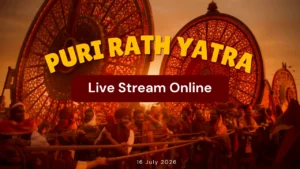
The Jagannath Rath Yatra traces its origin to ancient Puranic accounts describing Lord Jagannath’s annual journey to visit his aunt at the Gundicha Temple, a tradition carried out today through three chariots along a 3 km route. Historical records and temple inscriptions place organized celebrations of this festival centuries before the modern era, making it one of the oldest continuously observed chariot festivals in the world. Its significance rests on the belief that any devotee, regardless of caste or background, can witness and touch the deities during the procession, a departure from restricted temple access during the rest of the year. The 2026 observance falls on 16 July, drawing an estimated 10-20 lakh devotees to Puri. This article covers the historical roots and religious meaning behind the festival’s continued scale.
Understanding this history helps explain why the festival draws such enormous crowds and why the procession follows the same route every year. The Rath Yatra Puri 2026 travel guide places this historical background within the broader visitor guide, and the sections below trace the festival’s origins and meaning.
Table of Contents
ToggleWhat Is the Historical Origin of the Rath Yatra?
The historical origin of the Rath Yatra lies in Puranic scripture describing Lord Jagannath’s yearly visit to the Gundicha Temple, understood as the home of his aunt Gundicha. Temple records and regional chronicles document organized celebrations of this journey for centuries, with the Jagannath Temple itself dating back to construction efforts by regional rulers of ancient Odisha. The festival has continued without significant interruption through changing political rule across the region.
Why Does the Festival Hold Religious Significance?
The festival holds religious significance because it allows devotees of any background to view and approach the deities outside the temple’s normally restricted sanctum. This open access reflects a core belief that Lord Jagannath extends his presence to all people during the Rath Yatra period, regardless of caste, religion, or social standing. The event draws pilgrims from across India and international ISKCON communities for this reason.
Reasons devotees consider the festival significant:
- Witness the deities outside the restricted temple sanctum
- Participate in pulling the sacred chariot ropes
- Receive Mahaprasad as a shared communal offering
- Observe rituals unavailable during the rest of the year
How Has the Festival’s Scale Changed Over Time?
The festival’s scale has grown substantially in recent decades, with Odisha Police managing roughly 15 lakh devotees on the opening day in 2025 alone. Over 20 lakh devotees received Mahaprasad during that same festival week, reflecting both population growth and increased travel access to Puri. The 2026 procession is projected to draw a similar or larger crowd of 10-20 lakh attendees.
| Aspect | Historical Note |
|---|---|
| Origin | Rooted in Puranic accounts of Lord Jagannath’s yearly journey |
| Continuity | Celebrated without significant interruption for centuries |
| Modern scale | 10-20 lakh devotees projected for 2026 |
The Rituals That Preserve This Tradition
Many of the festival’s oldest rituals remain unchanged today, forming the backbone of the modern celebration. famous rituals of the Puri chariot festival documents the specific ceremonies, from Pahandi to Chhera Pahara, that carry this historical tradition forward each year.
Did the festival exist before modern transportation made travel to Puri easier?
Yes, the Rath Yatra predates modern transportation by centuries, with pilgrims historically traveling on foot or by bullock cart across long distances to reach Puri.
Is the Jagannath Temple the only site associated with this history?
No, Ahmedabad, Kolkata, Vrindavan, Mumbai, and Chennai each host related Rath Yatra processions, alongside ISKCON events in London, New York, and Sydney.
The Deities Behind the Historical Journey
Understanding why Lord Jagannath, Balabhadra, and Subhadra make this journey each year requires knowing the mythological story behind their wooden forms. the legend of Jagannath, Balabhadra, and Subhadra covers the carpenter Vishwakarma’s role and the deities’ distinctive unfinished appearance, both central to the historical narrative behind the festival.