
It feels like cold wet silk is touching my face when I sit on the steep stone steps and see the dark waters swaying below. It is 5 o’clock in the morning. While yoga groups and tour groups are active on the southern bank of the river, the north curve of the crescent is occupied by mystics. One lighted oil lamp passes the steps silently through dark blue hour.
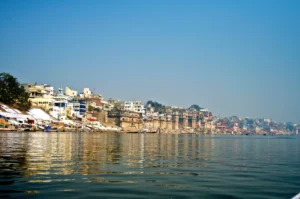
This is Panchganga Ghat which can be interpreted as a gorgeous and magnificent architectural construction completely devoid of the present. While the center of Kashi means the wild and flamboyant public heart, this northern site means the peaceful and dense mind of the city. As I have spent countless early mornings moving through grandiose stone constructions and if you really want to escape from noisy groups of tourists and get to the city’s past, you need to come here.
The Five Invisible Rivers: Myth and Architecture
To understand why the stones on the Panchganga ghat possess such great spiritual value, one has to see beyond the physical aspect of the place.
- The Sacred Confluence
From the very name of the site, one can see that it gets its mythology from a rich cosmic background. The Vedas describe it as the point where five rivers are supposed to meet. The river being pointed out is no ordinary river for besides the Ganga, the space hides the invisible channels of the Yamuna, Saraswati, Kirana, and Dhutapapa. Bathing at the site is believed to give five times more benefits than at any other site of Kashi Ganga.
- A Towering Sandy Phantom
When you glance above the river, one of the most impressive architectural landmarks in Northern India attracts your attention: the vast Alamgir Mosque. This building, constructed in the 17th century by the Mughal ruler Aurangzeb, stands over the remains of an ancient Vishnu temple. With its immense sandstone walls and crisp geometric shapes, the mosque raises high above the bathing stairs. By the way, the combination of Islamic architecture with classic Hindu steps emphasizes the dense, multifaceted historical landscape of Panchganga ghat Varanasi.
Arriving: A Guide to the Experience of a Trip
To reach this northern point of interest, a traveler needs to consider his/her journey carefully as it is located far away from the central drop-off points like Godowlia Crossing.
- The Alleys and the Approach
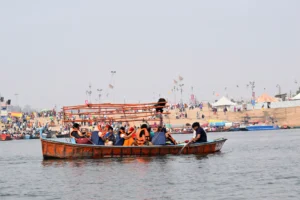
Walking through the old town maze is the best way to experience the destination upon your arrival. If you begin your journey from the main Dashashwamedh location, you will navigate through the slim, shadowy alleys of Thatheri Bazaar and Chaukhamba Gali and see both old houses and small spice shops. The walk can be completed within 30 minutes and provides a unique sensory experience. Another option would be taking a private wooden boat from the center of the town for approximately ₹400 per hour, making it more comfortable for you to travel along the river without being stuck in traffic.
- The Kartik Lantern Festival
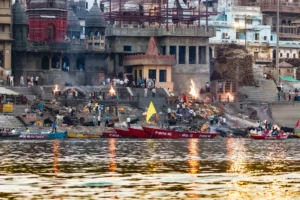
Travelers lucky enough to be in this region at the moment when the holy Hindu Kartik month is being celebrated will witness how this peaceful Panch ghat transforms into a real fairyland. The local residents place tall bamboo sticks on the side of stone stairs and hang beautiful (Akash Deep) wicker lanterns high in the air.
Once the night descends, the innumerable soft amber orbs are illuminated in the dark riverfront, forming a mesmerizing sky of artificial stars meant to lead ancestral souls. Being on the stone staircase beneath the light of these shining lanterns becomes a memory that cannot be forgotten for eternity.
Secret Hiding Spots: The Masters of the Maze
Nestled in the high stone staircases and back alleys right at the water’s edge are amazing historical spots that most common day-goers miss out on completely.
- Sri Ramananda Ashram
Just some steps away from the central bathing area is the ancient Sri Ramananda Ashram. It is a peaceful oasis that was the place where the medieval saint-poet Kabir had his first initiation by Swami Ramananda. The place is serene and calming with the sound of flowing water and ancient stone pillars smoothed out as a result of centuries of monks practicing meditation.
- The Riverside Stone Ledges
In the heat of the day, copy the local sadhus and go into the cool stone chambers called guphas that are actually carved into the lower retaining walls of the ghat itself. These chambers are cool even when the afternoon heat can be severe. You can sit here comfortably on a stone ledge for hours, have a ₹20 steaming hot clay cup of ginger tea from the vendor passing by, and watch local kids jump from the higher balconies down to the Panchganga ghat water below. For a wider outdoor perspective, our India trekking guide provides additional ideas for an active itinerary.
The Craft of the Loom: Weaving into the Unknown
To truly know Kashi, you need to leave the river’s side, and one afternoon in Madanpura will give you some idea of the craft of weaving. It is indeed the heart of the weaving world made up of Muslim families who have been providing silk cloth for several centuries (more than 500 years).
In a small and dark residential workshop, you will experience the wonder of an art that takes many hours to create. The sounds of the traditional loom keep reciting poetry while two artisans work tirelessly on the friendliest of wooden pit looms. You may spend hours wondering how slow fashion can produce such incredible silver and gold threads that eventually turn into beautiful pieces of art.
If you wish to know Varanasi beyond tourist shops, a textile walk would be a great discovery.
Is it safe to take a dip in holy waters at this northern place?
Yes, the water at Panchganga ghat is believed to be reasonably clean and less congested than that at central bathing areas because it is located upstream, away from the heavy boat traffic. But the currents can be surprisingly strong and deep there; it is better to hold onto the heavy iron chains fixed into the stone terracing before stepping into the Kashi Ganga current.
When is the most optimal timeframe for shooting remarkable images in this location?
The best time for visual storytellers is between 05:30 AM and 07:00 AM. Due to the presence of steep stone steps at Panch ghat, the sun beams bright light onto the steps, thereby providing amazing, and high-contrast photographs of the less crowded pilgrims and stone buildings of ancient formation.
Is it possible to access the water body by car or auto-rickshaw?
Motorized transport cannot reach this point. The nearest drop-off point is Maidagin Crossing, from where a lovely walk for about 15 minutes through ancient streets with foot traffic is necessary to reach the actual river steps.
Is it possible to bring cars or auto-rickshaws to the waterfront in this particular spot?
No, there is no route for motorized vehicles to the waterfront from this place. The closest drop-off point for vehicles is Maidagin Crossing, and from there one has to walk for about 15 minutes downhill through the old walkways to reach the steps leading to the river. If traveling with large baggage and older people who have problems climbing steep steps, taking a river boat will be a good idea.


