
Sandhi Puja is marked at the chronological point when the Maha Ashtami gives way fully to the Maha Navami. For this reason the time window is known traditionally as Sandhikkhon and lasts exactly 48 minutes. For the exact dates of Ashtami and Navami this year, see our Durga Puja 2026 tithi calendar.
In fact the length of this offering is a reflection of ancient astronomical timekeeping. Based on Hindu traditional astronomy, time is represented through danda (or dandi). 1 danda is 24 minutes. Two dandas make a muhurta (48 minutes). The sandhikkhon time of day is fixed mathematically to cover two dandas:
- The last half-hour (1 danda) of the Ashtami tithi.
- The first twenty-four minutes (1 danda) of Navami tithi.
Because the Bengali tradition uses more than one method of calculating the position of moon planets, traditional almanacs produce quite a difference in timing of the sandhikkhon of 2026. So for two major lines of reasoning the times for the 2026 event would differ:
Bishuddha Siddhanta Panjika (Drik / Scientific Computation Method)
The ritual will take place on Monday, 19 October 2026 between 10:28 am to 11:16 am. These times are also adhered to by places like Belur Math and modern pandal communities. About the point of the transformation (balidan kshan), the timing occurs at approximately 10:52 am.
Gupta Press / Prachin Panjika (Surya Siddhanta / ancient method)
The ceremony will occur on Monday, 19 October 2026 from 07:26 am to 08:14 am. Such times are mainly respected by old-style aristocratic families, traditional landed gentry and orthodox committees of the community. About the point of transformation (balidan kshan), its timing has been approximated at 07:50 am.
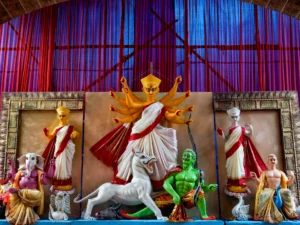
What Is Sandhi Puja?
Sandhi Puja is the highlight of the five-day festival when spiritual energy is at its peak. By mythology, it is the moment that changes the course of the entire fight between Goddess Durga and her enemy forces, documented in the Devi Mahatmya (Chandi) saga.
When Goddess Durga was fighting the buffalo demon Mahishasura, his two greatest minions, Chanda and Munda, resorted to a sneaky surprise attack from the back. Their treachery so enraged the Mother that her once radiant and loving face turned pitch black with anger. She sent out her fiercest cosmic warrior from her deep frown and the opening of her third eye: Goddess Chamunda (Kali in a fearsome form). Her hair was flying in all directions, she wore a necklace of severed heads and her eyes were like burning coals as Chamunda, in a flash of divine wrath, beheaded both demons, the root of the tyranny was cut-off.
The 48-minute sandhikkhon is the time of this transformation of the universe. It is not a strict Ashtami or a strict Navami. It represents the moment when darkness faces light, and the battle-hardened divine mother is worshiped with quiet awe. The festival’s ritual calendar actually starts days earlier, at Mahalaya.
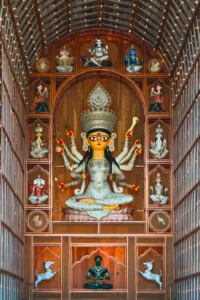
The Rituals of Sandhi Puja
The calling of Devi Chamunda during sandhikkhon is full of aural and audible drama, Eyananything offered during these moments is bound by the holy cosmic number 108:
108 pradeep (Earthen Lamps): set out in concentric semi-circles in front of the idol are 108 silver or earthen lamps filled with clarified butter (ghee) or mustard oil. These are simultaneously ignited by the devotees and the priests at the onset of the transition to generate a glow of celestial fire in order to bestow enlightenment.
108 Lotus Flowers
The priest presents a garland/mound of the 108 Lotus Flowers on to Chamunda. This refers to the legend of Akal-Bodhon, where Lord Rama was about to offer his own eye, when Goddess appeared at this hour.
108 Bel Leaves (Bilva Patra)
Dedicated garland of 108 fresh three pronged bel pata signed with sandalwood paste is hung around the idol to appease Shiva and Shakti.
Culmination of Sound
As the exact half point comes; the tempo of the dhak (great Bengal drums) rises to a deafening fever pitch. The drum beats are synchronized to play with the high-pitched screech of the shankha (conch shell) as well as the rapid, reverberating clang of the kansor ghanta (brass gong), which shall race to resemble the roar of a chaotic war in the cosmos.
The Tope Firing
In traditional royal houses like Sovabazar Rajbari, an old tope (cannon/gun) would be fired from the courtyard precisely at the moment the Ashtami tithi ended and Navami would commence, instructing neighboring villages to light torches.
Symbolic Balidan
Ancient animal (blood) balidan is now universally replaced by symbolic offering of plants in most of the urban and domestic temples. At the 24th minute, the priest makes a clean single stroke incision across a whole ash gourd (chalkumro), sugar cane stalks, or green bananas smeared with red vermilion, symbolising human egocentricity and malevolence.
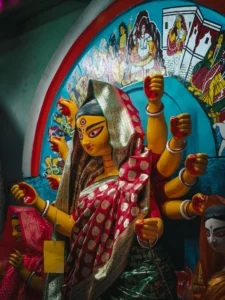
Where to Witness Sandhi Puja in Kolkata?
One of the highlights of the Sandhi Puja is observing the striking contrast between traditional household courtyards and community-scale set-ups. Just two days later, that same energy shifts toward farewell at Visarjan.
Guidelines for Visitors
Arrive in advance: Arrive a few minutes before the main event to avoid missing anything. The inner courtyards (thakur dalan) and pandal sanctums can accommodate very few visitors. For safety, entrance gates will be completely closed just before the beginning of the ritual to avoid a stampede of people.
Door Closure During the Ritual: As soon as the priest starts the invocation of Chamunda, the temple doors or pandal enclosures will be closed. Entry or exit during the 48-minute duration of the ritual will be restricted.
Do-Not-Detect: The whole point of Sandhi Puja is to be absorbed in the ritual, not to take pictures of it. So, no use of flash photography, selfie sticks, and conversation. Your gadgets need to be silent and kept in your pockets during the lighting of the lamps and balidan (symbolic sacrificial blood offering) ceremony.
Sandhi Puja vs Ashtami Anjali vs Kumari Puja
The devout and even those experiencing their first journey often confuse the large ceremonies that take place during the eighth day. To help clarify, the table below explains the timing, the spiritual significance and whom you need to approach each time.
Sandhi Puja
- Exact Timing: It lasts for two 24 minute periods; one at the end of Ashtami and one at the beginning of Navami, the total being 48 minutes.
- Aspect of Deity: God is worshiped at this time as Chamunda or Kali, the fierce destroyer of demons.
- Core Ritual: It involves lighting 108 earthy clay lamps (pradeep), presenting 108 lotuses, and a symbolic offering of vegetables through a vegetable sacrifice (balidan).
- Role of the public: Worshippers are to remain silent, reverently watching the head priests carry out the whole ceremonial procedure.
- Sounds of Atmosphere: Fast-paced and loud dhak drumming, blowing of conch shells, and crashing brass gongs (kansor ghanta) make up the soundtrack.
Ashtami Anjali
- Time when it is done: In the mid-morning of Maha Ashtami, mostly from 8:00 AM to 10:30 AM
- Form of the deity: She is worshiped as the ten-armed Mahishasuramardini, the bright and protective Universal Mother.
- Ritual at the core: Devotees sing devotional hymns on a sacred level collectively in Sanskrit while they make flower and bel pata offerings.
- Participation level of the public: The devotees have to abstain from foods and participate in the morning anjali ceremony to complete it, so community participation is very high.
- Environment: Acoustically the whole environment seems like a concert hall with people humming the Sanskrit mantras to the rhythm of one another led by the priest and it creates a kind of trance-like atmosphere.
Kumari Puja
- Precise Timing: Celebrated at the dawn of Maha Ashtami i.e. around 9:00 AM
- Appearance of God: It is the goddess Mahamaya living, pure, and active in a little girl.
- Main Ritual: Feet of the little girl are ceremoniously washed as well as she is decorated with flowers and the traditional arati is performed.
- Duty of public: It is a very respectful, sacred crowd at which people witness the ceremony, mostly when it is performed in Belur Math.
- Environment: The music is gentle and soothing devotional songs, slow prayer bells, and rhythm of conch blowing, which altogether give an acoustic environment characterized by these.
Frequently Asked Questions
1. What is the timing of Sandhi Puja?
Sandhi Puja will be celebrated on Monday, 19 October 2026. It will begin at 10:28 AM and last till 11:16 AM based on Bishuddha Siddhanta almanac (followed by Belur Math). As Gupta Press / Prachin Panjika, it will take place from 07:26 AM to 08:14 AM.
2. What is the duration of Sandhi Puja?
Pujas, Mostly Sandhi, lasts for 48 minutes (one Vedic muhurta). These 48 are perfectly split between the last 24 minutes of Ashtami and the first 24 minutes of Navami.
3. What is Sandhi Puja all about?
Sandhi Puja is a festival that commemorates a very dramatic moment where Divine Durga took on the appearance of Goddess Chamunda and severed the heads of demon generals Chanda and Munda. This is when the time transition from the 8th to the 9th lunar day happened.
4. Why are 108 lamps lit in Sandhi Puja?
These 108 pradeep, known as deodars or dipti, represent the triumph of knowledge over darkness and of God over ignorance. Number 108 in the Hindu Vedic cosmology is symbolic of perfection, completeness and auspiciousness.
5. Are animal slaughter sacrifices still being carried out at Sandhi Puja?
Animal sacrifices are now completely banned at Sandhi Puja. So it’s done that, in most of the temples and homes the symbolic vegetable offerings like ash gourd (chalkumro), sugarcane or fruits painted with the red vermillion are used in place of actual sacrifices. These items are also called balidan.
6. Can non- devotees watch Sandhi Puja at pandals?
Definitely yes! But you must get there about 45 minutes before the event. During the 48-minute ritual, barricades are often shut to maintain sanctity and regulate flow of crowds.
7. How is Sandhi Puja different from Ashtami Anjali?
In Ashtami Anjali, which is offered a couple of hours before the ritual, the devotees who are keeping fasts offer flowers etc. while in Sandhi Puja a priest performs an austere ritual to the fierce avatar of Chamunda.


