
Located in central Odisha, Dhenkanal district has far more in a modest footprint than this low-key region puts out. Such sights as a hilltop Shiva temple dating from the 13th century, accessed by a dusty pathway lined with a thousand stone stairs, the seat of a 19th-century Odisha-born religious sect, and a kings’ palace you can stay in a prominent place, plus the Brahmani River flowing through meadows and hills that have only recently opened to visitors. Here’s a comprehensive list of places to visit in Dhenkanal region, based on the type of experience you seek.
Dhenkanal at a Glance
Dhenkanal exists within a landlocked region located in Odisha, positioned in almost the exact middle of the state, surrounded by Kendujhar to the north, Jajpur to the east, Cuttack to the south, and Angul to the west. It is a district of approximately 4,452 sq. km of terrain which is home to around 1.19 million individuals, according to 2011 census statistics -similar to Rhode Island in size. The Brahmani River is the major water source in the district in a unique way since it encompasses not only flatlands, but uneven hill ranges along the southern edges of the district and here exists the most places for both historical and tourist sites.
Dhenkanal tourism has three main directions: religion represented in Kapilash Temple and Joranda Mahima Gadi as both the places are of worship of enormous importance; heritage represented mostly through the fact that the district boasts of more than 420 years old princely history; and nature represented in hills, forest paths, and rivers that can be explored thoroughly by slower means of transportation. The district is a real gift for those who have already visited the main tourist destinations in Odisha: Puri, Konark, and Bhubaneswar.
Top Places to Visit in Dhenkanal
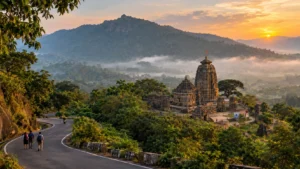
- Kapilash Temple: A 13th-century hilltop Shiva temple with panoramic vistas reached by over 1,300 stone steps or a curving road.
- Joranda Mahima Gadi: The religious seat of Mahima Dharma, an Odia religious sect of origin and its occasional fairs, which has one of the largest gatherings of a fair in the state.
- Dhenkanal Palace (Rajbari): The erstwhile royal estate of the Bhoi kings that is now a living heritage homestay.
- Saptasajya Hill: A beautiful hillock linked to Ramayana and Mahabharta story.
- Saranga (Anantashayana Vishnu Temple: This temple features an extraordinary reclining Vishnu temple embedded in the rocky bed of the river.
- Astasambhu Siva Temples: Eight temples dedicated to Shiva assembled as a group.
- Jatan Nagar Palace: A former royal palace about 5 km away from Dhenkanal town with an independent history.
Temples and Spiritual Sites
Kapilas Temple
Kapilas temple or Mahadev Chandrashekhar Temple, is the most sacred and religious temple in the Dhenkanal district. Built by King Narasinghdeva I of the Ganga Dynasty in the year 1246 CE, with a height of about 2,239 feet (682 m) above sea level. It is situated in the north-east direction from the town of District Dhenkanal at a distance of about 26 km, with a main tower of height 60 feet. It is situated near two holy ponds, namely Payamrta Kunda and Marichi Kunda. Visitors have the option either to take a holy trip climbing 1,352 stone steps or take a winding approach road through Barabanki.
Joranda Mahima Gadi
Joranda Mahima Gadi, about 24 km north of Dhenkanal town and 75 km from Bhubaneswar, is the religious epicentre of Mahima Dharma, a unique Odia sect founded by Mahima Swami or Mahima Gosain. After meditating on Kapilash hilltop in the Dhenkanal region for 12 years, Mahima Swami established the Mahima Dharma in Odisha. The founder renounced idol worship and expressed reverence only towards Alekha, a formless solar aspect of the Lord. Mandirs and monasteries in the Joranda gadi are open for darshan from around 5:30 AM to 9:30 PM. The sanctuary of the gadi is Joranda Mela (also called Magha Mela), held every winter on the full moon day in the purnima month of the Hindu calendar (called Magha purnima in the Odia calendar and which falls mostly in January or February), when hundreds of mahima sadhus and lakhs of devotees congregate to celebrate the ancient mela that has been held without any problems since 1874.
Vishnu reclining at the Saranga’s Anantashayana Vishnu Temple on the Brahmani River is a grand image of Vishnu resting on the natural rock bed; one of the most stunning temple sites in the district and also offers some of the best photographs. The Astasambhu Siva Temples complex of eight different Shiva temples and the Annakoteshwara Temple at Latadeipur, which also has a stone shivalinga, complete the temple circuit of the district for those who have a bit more time to delve deeper than the headline sites.
Nature, Hills and Waterfalls
Saptasajya Hill, 11 km from Dhenkanal town, is a beautiful tourist destination and a place of genuine mythological significance; legend has it that Lord Rama and the Pandavas took rest here during their exile rounds, adding a touch of history and culture to its scenic views. The hilly forest slopes surrounding Dhenkanal Palace itself on Sristigundi Hill and hiding in the woods behind the yellow palace are excellent for nature walks right from the heritage homestay, handy if you’re staying there and seeking an easy outdoor ramble. A longer nature-based fit can be had with the district’s relatively close-access position to the Satkosia Gorge landscape (best accessed from Nayagarh and Angul districts), and some multi-day Dhenkanal cortical journeys link the two areas.
Heritage and History of Dhenkanal
Dhenkanal district’s history as a princely state is lengthy. The royal ruling state was established in approximately 1529-1530 CE by Hari Singh Vidyadhar, a commander from the branch of the Gajapati Bhoi Dynasty of Khurda. As local tradition holds, the district’s name was adopted when a dying chieftain (Dhenka Savara), who was suffering defeat, requested that his name be entrusted to his conquerors, and this was later fulfilled by Hari Singh Vidyadhar by naming his new principality “Dhenkanal” (Dhenka + anala (hearth)). The Bhoi dynasty, which ruled for 418 consecutive years, until the accession of the state in 1948, ruled Dhenkanal until the incorporation of the two princely states of Dhenkanal and Hindol into the Indian Union that same year.
The most visible physical remnant of that history is Dhenkanal Palace (Rajbari), the administrative residence for the Bhoi royal family, perched on Paniohala Hill in Dhenkanal town. Since becoming a heritage homestay in 1992, this former royal family home has been renovated to provide accommodation in the very setting that used to be its sprawling footprint. A second royal complex on a different hill, Jatan Nagar Palace, a 5 km drive from the town, has its own local tale, believed to be a 100-room palace built by one of the district’s rulers.
Best Time to Visit Dhenkanal
November-February is ideal; cooler and drier temperatures make the climb up to the Kapilash temple, visits to surrounding areas and sightseeing generally so much more enjoyable than in the popular summer months. The best chance to experience the district bursting at the seams is to time your visit during the Magha Purnima (Joranda Mela), a prudent advance booking of your hotel accommodation is a must as the crowds are overwhelming. Summers (April-June) are hot, while the monsoons (July-September) are not really suitable for trying the Kapilash climb due to the stone steps.
How to Reach Dhenkanal?
Air: Biju Patnaik International Airport, Bhubaneswar is the most proximate air terminal, approximately 75-90 km from Dhenkanal town by different routes.
Railways: Dhenkanal Railway Station (DNKL) is located on the East Coast Railway, it is an integral part of the Cuttack-Sambalpur line of the East Coast Railway, providing direct rail connectivity to Dhenkanal district. Cuttack is located 55 km from Dhenkanal on the main trunk route between Howrah and Chennai. The main trunk extends even further to Delhi Mumbai Kolkata Chennai Hyderabad, and Bengaluru.
How to reach by road: Road connectivity is easy to prove from both the directions via the National highway 55, which passes through Dhenkanal. Road services and taxis are average from Cuttack, Angul, and Bhubaneswar.
Where to Eat and What to Buy?
Dhenkanal’s food culture is representative of the larger Odia cuisine: rice-based thalis, dalma (Odia speciality of lentils and vegetables) and seasonal river fish due to the proximity of the Brahmani River around the district. Stay at the Dhenkanal Palace itself, which is an immersion into the local cuisine, while the heritage homestay serves up home-cooked Odia cuisine as part of the stay. For shopping, the district is neighbouring Nuapatna (home to ikat weaving and ilkal-style sarees) and Sadeibareni (home to Dokra metal-craft work) being popular options, along with other craft-focused villages in a wider Dhenkanal-area itinerary, although they sit outside district jurisdiction.
Sample Itinerary for Dhenkanal
1-Day Itinerary
- Morning: Kapilash Temple (climb or drive up; time required: 23 hrs return)
- Midday: Dhenkanal Palace (Rajbari), a tour or lunch stop if not based in Dhenkanal.
- Afternoon: Saptasajya Hill for a shorter sightseeing tour.
- Evening: Return through Dhenkanal town.
2-Day Itinerary
- Day 1: Arrival at Dhenkanal Palace and check-in; later, explore Jatan Nagar Palace and stroll through the wooded slopes behind the palace. Relax in Dhenkanal town.
- Day 2: Kapilash Temple in the morning; drive (30 mins. Early afternoon to Joranda Mahima Gadi (approx. 24 km). If this timing works out, we might even do the drive to Saranga’s Anantashayana Vishnu Temple on the Brahmani River in the early afternoon and drive back.
Include a half-day for the Astasambhu Siva Temples and Annakoteshwara Temple, and head towards the Satkosia Gorge landscape if you are combining Dhenkanal with a more comprehensive central-Odisha wildlife and heritage tour.
Frequently Asked Questions
1. What is Dhenkanal famous for?
Its 418-year history as a princely state under the Bhoi dynasty, and a few notable landmarks: Kapilash Temple, the Joranda Mahima Gadi where Mahima Dharma has its headquarters, plus Dhenkanal Palace.
2. How many steps are there to climb at Kapilash Temple?
Around 1,352 stone steps. If that sounds punishing, you can instead follow the twisting road that approaches via Barabanki.
3. What is the Joranda Mela?
An annual festival on Magha Purnima, which falls in January/February, at Joranda. Lakhs of devotees arrive at the Mahima Dharma headquarters, making it one of Odisha’s largest and most distinctive religious fairs.
4. Can I stay inside a real palace in Dhenkanal?
You can. Dhenkanal Palace used to be the seat of the Bhoi dynasty and was converted into a heritage homestay back in 1992, offering restored rooms to guests.
5. How far is Dhenkanal from Bhubaneswar?
Roughly 75 to 90 km by road. The exact distance depends on the route you choose.
6. What is the best time to visit Dhenkanal?
November through February works best, since the weather is cooler and more comfortable. That matters a lot when you are climbing at Kapilash and touring outdoors all day.
7. Is Dhenkanal good for a 1-day trip from Bhubaneswar?
It is, if you are focused on Kapilash Temple and Dhenkanal Palace. But a second day lets you add Joranda and some of the district’s quieter sites without any rushing around.

