
Durga Puja in Kolkata has created a unique rhythm of culinary experience. Ashtami is exclusively vegetarian, Navami is all mutton, and every day between is its own street-food logic. This guide will take you through the Durga puja street food Kolkata scene, the bhog menu Durga puja tradition, restaurants that are staying open after Durga puja and what you can realistically order yourself if your pandal is a food-focused one. First thing to say is that this information may be old, and the actual food booths locations are quite unpredictable, so you really cannot know unless you try it yourself. The same is true for the pandal- specific bhog coupon procedures and their change year to year, so it is best confirmed on the ground or through current-year local reporting close to the date and the only thing that this page really gives you is the stable, reliable system – (institutions traditions timing) and leaves the yearly-changing details to your imagination. Planning what to wear for all this eating and walking? Check our Durga Puja dress code guide.
The Puja Food Calendar
| Day | Food tradition |
| Mahalaya | Home-cooked breakfast, often luchi-alur dom; the fasting/ritual mood is lighter than the main Puja days |
| Shashthi | First evening of pandal-hopping street food (phuchka, rolls, chop) dominates over home meals |
| Saptami | Street food continues; many families eat out for the first time this Puja |
| Ashtami | Strictly niramish (vegetarian) no meat, fish, or (in observant households) onion and garlic. Luchi-alur dom, bhog at pandals |
| Navami | The meat day Navami mangsho, usually kosha mangsho (slow-cooked mutton), is the defining meal |
| Dashami /
Vijaya Dashami |
Lighter food, Sindoor Khela in the morning, sweets exchanged; many families eat simply before the emotional visarjan (immersion) |
| Bijoya (post-
Dashami) |
Home visits begin narkel naru, nimki, sandesh, and sweets are served to every visitor |
Bhog: The Sacred Meal
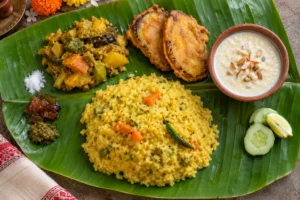
What’s in a standard bhog
A typical bhog, the deity’s food, then being shared with worshippers, is made of only vegetarian items, and is mainly centred on a constant set of staples: khichudi (rice with lentils), a mildly spiced dish, labra (curry made from mixed vegetables, like pumpkins potatoes brinjals), seasonal vegetables are used. Besides these dishes, beguni (fried slices of eggplant), a sweet-tart chatni generally of tomatoes or mangoes, and payesh which is a rice pudding, are the items. If there is some pandal, then that serves a fried item, a fritter or a papad. The main sarbojanin (community) pandals distribute bhog free of cost. This is one of the most constant features about Puja food: people in Ashtami and Navami usually receive it during the noon in such large places. Yet, what exactly the serving system is, the method and everything else, differs from pandal to pandal and each year.
Which pandals serve public bhog, and how to get a coupon
Some pandals use only queueing and serving the bhog to whoever comes first, whereas others hand out numbered coupons and then you come and get your bhog at a certain time. In the meantime, larger pandals will stop distributing when their stock runs out of their supply. In the past reporting, the Ballygunge Cultural Association has been singled out more exactly, its bhog service is the reason that it is a component of the curated pandal-hopping tour. Other than that, avoid taking the list of “pandals serving bhog with coupons ” fixed as a reliable source. Check one-by-one each of the committees or look for articles about local Kolkata news coverage right before or just after the festival since coupon systems and serving times for these are announced only close to the date, not months ahead.
Niramish rules
Non-veg food items are excluded from Niramish eating habits, besides that, in some very strict households, even the use of onion and garlic is completely banned because, these being categorized as “tamsik”, are considered stimulating and are this way kept away in a day devoted to prayers. This explains the unique taste of dishes prepared on the day of Ashtami, which are definitely different from the usual vegetarian Bengali food. Spices like ginger, cumin, and whole spices are used to extract flavor, whereas a significant proportion of Bengali curries depend upon a base flavor made up of onion and garlic only.
Ashtami Is Vegetarian, Navami Is Not
This single fact trips up more visitors than anything else about Puja food — plan your meat cravings around it.
Ashtami: luchi-alur dom
Luchi (puffed bread pieces, prepared with white flour rather than the dough used for rotis) served with alur dom (a fairly dry spiced potato dish, traditionally prepared without onion-garlic on Ashtami) is a basic meal that goes together as breakfast or lunch meal for the Bong families on the given day, and quite frequently for lunch too. It is a very straightforward preparation without any ornamentation, and that is exactly what it is about as one goes: Ashtami cooking is very modest.
Navami mangsho kosha mangsho, where to find the best in Kolkata
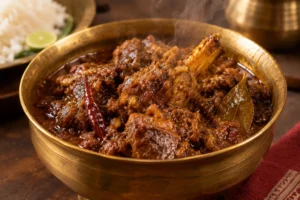
Navami mangsho brings a major change in the mood. On the day of Navami one can’t miss the opportunity of having kosha mangsho, mutton slowly-cooked in a thick dark spiced-up sauce till it becomes so dry the gravy has been totally reduced, the favourite dish of the majority, whether at home or in restaurants.
A few well-known Kolkata places have made their names solely by specializing in this one dish:
Golbari (Shyambazar, North Kolkata), they have been repeatedly recommended for excellent kosha mangsho; a real Puja week line-up is what you need to expect here.
6 Ballygunge Place, a very nice all-round Bengali eatery where you can have a proper Navami mangsho meal to your heart’s content. Bhojohori Manna (chain of outlets), not only quality-wise they are very consistent, but it will be much easier for you to find a table than at Golbari.
Kasturi, another big name in Bengali restaurant chains famed for its mutton dishes. Come the day of Navami itself, you won’t find these places with an open seat even though they serve their regular daily menu as well.
Don’t wait for them until you have to; go there earlier in the morning; alternatively, enjoy a long queue at the counter as the price for your meal.
Street Food Near Pandals, Area by Area
The street food of the event week is in tents, which are erected for temporary use only. As a result, the names and street locations of the stalls change from year to year. What remains unchanged is which proven street-food walking zones in the event week become crowded.
North Kolkata
During Puja week, the function around Shyambazar and Hatibagan is taken over by phuchka and telebhaja carts. The tables and stalls of Calcutta’s College Street, established long ago as the cheapest, tastiest place to have something to eat at if you are close to the university and book market, remain congested even into the evenings.
South Kolkata
Gariahat and the adjacent avenues surrounding Deshapriya Park become a seamless stream of pop-up eating lanes during Puja phuchka, ghugni (spicy yellow-pea curry, consumed as snack), moghlai porota (egg layered, stuffed paratha) and rolls are fat on the street. Kobiraji (a Bengali derivative of breaded, deep-fried cutlets of chicken or fish) is a South Kolkata specialty that one must in particular look for rather than assume a vendor here will offer it.
Salt Lake
The sector markets in Salt Lake particularly around AA Block and Central Park) marks the seasonal boom cycle of stalls (but are almost always slightly less frantic) compared to the North/South Kolkata crush, and can be a reasonable bet for good street food at least without the insane crowd.
Core items to try anywhere in the city: Phuchka (the sharper version of pani puri, more punch and sour coming from the tamarind), chop mochar chop (bananaflower fritter), dimer chop (egg fritter), beguni rolls, kathi rolls, eggand-mutton or eggand-chicken, dimer devil (a kolkata version of a breaded egg, deep-fried and stuffed), telebhaja (various fritters and mainly popular in the evening), and kolkata-style biryani (more eaten in kolkata than in the rest of the country, takes the form of a complete potato in each serve).
Legendary Kolkata Institutions Worth the Detour
Mitra Café (Shyambazar) -an old-style “cabin” that has been serving delicacies in mutton cutlets and fish fry since the 20th century; genuinely worth the trip; expect a wait during the Puja season.
- Basanta Cabin (College Street) -another classic cabin, noted mainly for its fish fry and old-Calcutta atmosphere.
- Dilkhusha Cabin – almost identical in time of origin and the same kind of attraction.
- Nizam’s (New Market) – the restaurant counts as the origin place of the Kolkata kathi roll; it is always busy and getting more hectic during the Puja period.
- K.C. Das, Balaram Mullick & Radharaman Mullick, Bhim Chandra Nag — the city’s longest running sweet shops that deliver quality sandesh and ros-gulla anytime of the year; though, during the Puja you will need to queue up for a longer period as people start gifting.
Honest note: Puja-week waits at all of these can run 30-60+ minutes at peak times. If you are considering the queue as an issue, then visit on Shashthi or Saptami instead of Ashtami/Navami evenings.
Restaurants Open During Puja + Booking Reality
Most established restaurants stay open through Puja, but expect limited menus, longer waits even with a reservation, and a strong recommendation to book 2–3 weeks ahead for anything mid-range or above — walk-ins during Ashtami–Navami evenings are a genuine gamble.
| Restaurant | Area | Cuisine | Price band | Booking needed? |
| 6
Ballygunge Place |
Ballygunge | Bengali | Midhigh | Yes, well ahead |
| Bhojohori
Manna |
Multiple | Bengali | Mid | Recommended |
| Kasturi | Multiple | Bengali | Mid | Recommended |
| Golbari | Shyambazar | Bengali (kosha mangsho) | Budgetmid | Not accepted
arrive early, expect a wait |
| Arsalan | Multiple | Biryani/Mughlai | Mid | Recommended
for groups |
| Peter Cat | Park Street | Continental/Mughlai | Mid | Recommended |
| Flurys | Park Street | Café/Bakery | Mid | Walk-in generally fine, expect a wait |
Late-Night Food for Pandal Hoppers
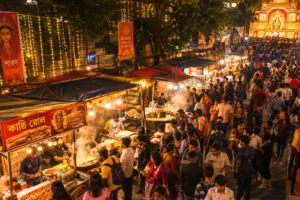
During the Puja week, food stalls like Kathi roll, phuchka carts and biryani counters around the pandal zones are the most congested areas usually stay open till past midnight because the crowd only thins out a little during Ashtami and Navami. Park Street and the pandal zones in the southern part of Kolkata are the last areas to get any food.
Bijoya Sweets & Home Visits
Bijoya Dashami marks the beginning of a very old tradition of visiting relatives and neighbors where usually sweets are the only things offered besides the regular meals. Narkel naru (coconut and jaggery balls), nimki (savory diamond-shaped crackers fried in oil), sandesh, and in many cases mishti doi (very sweet set yogurt). The whole thing is less about getting a particular item eaten than the social ritual of visiting. Coming with an empty hand is okay though arriving hungry would be wrong to say the least.
Puja Food on a Budget
A full day of eating under ₹300 is realistic if you stick to street food:
- Phuchka (6–8 pieces): ₹40–60
- Ghugni: ₹40–50
- A kathi roll (egg-chicken): ₹80–100
- Jhal muri (spiced puffed rice snack): ₹30–40
- A cup of tea/coffee: ₹15–20
- Telebhaja (a few pieces): ₹30–40
That’s a full day’s grazing for well under ₹300, before accounting for any bhog you’re offered for free at a pandal. Slot a food-focused evening into your plans using our 5-day Kolkata Durga Puja itinerary.
Vegetarian, Jain & Allergy Notes
Ashtami’s niramish tradition actually allows even very strict vegetarians to find a perfect meal without having to look citywide. Besides Ashtami, most Bengali sweet shops and many famous street snacks like phuchka ghugni telebhaja, beguni) are vegetarian by definition, but onion and garlic are normally used in Bengali dishes outside of the Ashtami restriction – so it’s necessary to clearly request a Jain meal as it is not the norm even for vegetarian items. Information on true allergies (nuts in sweets, gluten in luchi/rolls, dairy in payesh and mishti doi) is hardly visible in roadside stalls – if a person is allergic, a better solution is going to a proper restaurant to a pop-up stall where ingredient transparency is almost non-existent.
Food Hygiene During Puja
Food sold by hawkers on the streets during peak puja gatherings poses a lot of the same dangers as any big festival food scene that has so much food being sold: high-turnover of stalls means fresher cooking oil and other ingredients on sale at busy and crowded ones (a very helpful hint – a constantly queued stall means food comes out quickly), but it also increases the chance of a dishonest vendor giving low quality product because of that competition. Some helpful ways of avoiding getting sick are: choosing stalls that are visibly active with lots of turnover and a mix of people among whom you recognize some faces rather than those which only few people go to, avoid freshly-cut fruit or other stuff that have not been kept cold for some time, get yourself hand sanitizer which is usually not available at the street-level food stalls because there is no way for the stalls to provide that, and don’t eat all your street food in one go – instead, spread it out over the evening because there are quite a few puja nights, and suffering a bout of stomach troubles will definitely be more painful and a waste of time than skipping eating at one of those street stalls.
Frequently Asked Questions
What food is eaten during Durga Puja?
The flow is from street food (phuchka rolls chop) on Shashthi and Saptami, then pure vegetarian food on Ashtami, then mutton-based food on Navami, then sweet delicacies on Bijoya visits after Dashami.
What is bhog and can visitors eat it?
Bhog is a vegetarian offering (usually khichuri, labra, chatni and payesh) made to the goddess, which is later shared among the devotees. In most public pandals people are free to take the bhog and other people.
Which pandals offer free bhog in Kolkata?
All major sarbojanin pandals provide bhog. This is typically served around lunch on Ashtami & Navami but the menu as well as the coupon distribution system changes each year and you should consult the individual committees or read the local papers in proximity to the dates instead of an annual schedule.
Why do Bengalis eat mutton on Navami?
After Ashtami, which is purely vegetarian, comes Navami the final full day before the goddess’s journey home, the one day a year the greatest non-vegetarian feast in the culture is scheduled with the emphasis firmly on kosha mangsho.
Is Ashtami a vegetarian day?
Yes – Ashtami is observed as niramish (vegetarian, often without onion and garlic) across most Bengali households and at pandal bhog.
Are restaurants open during Durga Puja in Kolkata?
Yes, most are open, but be prepared for small menus, longer waits and that 2-3 weeks pre-booking is essential for anywhere good.
What street food should I try near pandals?
Phuchka, ghugni, kathi rolls, mochar and dimer chop, kobiraji cutlets, telebhaja, and Kolkata-style biryani with its signature potato.
Where can I eat after midnight during Durga Puja?
Near main pandal areas and along the Park Street stretch, rolls and biryani stalls continue till late past midnight on the Ashtami and Navami nights, when the pandal-hopping population has not yet dispersed.


