
Durga Puja in Kolkata is more than a festival. During these days, the city turns its streets into a colorful celebration of art, culture, and creativity. This amazing display of culture called “Durgotsav” was put in the UNESCO Representative List of the Intangible Cultural Heritage of Humanity in the year 2021. It has brought together millions of people of different caste, creed and geography in one big celebration of art, culture, music, food and religion.
You could be at any of those famous aristocratic houses on top of North Kolkata, or just standing amazed looking at the architectural masterpieces of South Kolkata’s modern theme installations, this exhaustive 2026 cultural, travel itinerary guide will give you all the necessary information you need for organizing your trip. If you want a ready-made day-by-day plan, see our 5-day Kolkata Durga Puja itinerary.
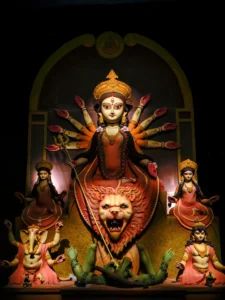
A Glance at Durga Puja 2026 Dates
The major festival of Durga Puja in 2026 is planned in mid-to-late October. Here is a complete list of rituals per the traditional lunar calendar.
| Festival Day | Gregorian Date | Lunar Phase (Tithi) & Core Ritual | Primary Observance & Focus |
| Mahalaya | Saturday, 10 October 2026 | Amavasya (New Moon) | End of Pitri Paksha, dawn invocation, eye-painting (Chokkhu Daan) |
| Maha Shashthi | Friday, 16 October 2026 | Shashthi Tithi | Bodhon (Awakening), Amantran & Adhibas; formal public unveiling |
| Maha Saptami (I) | Saturday, 17 October 2026 | Saptami Tithi begins | Nabapatrika Snan (Kola Bou river bath at dawn) |
| Maha Saptami (II) | Sunday, 18 October 2026 | Saptami-Ashtami transition | Continuation of Vedic Maha Saptami worship; citywide hopping peak |
| Maha Ashtami | Monday, 19 October 2026 | Ashtami Tithi & Sandhi juncture | Pushpanjali, Kumari Puja at Belur Math, Sandhi Puja |
| Maha Navami | Tuesday, 20 October 2026 | Navami Tithi | Maha Aarti, Navami Homa (Sacred Fire), Dhunuchi Naach |
| Vijaya Dashami | Wednesday, 21 October 2026 | Dashami Tithi | Devi Boron, Sindoor Khela, Visarjan (River Immersion), Bijoya |
Panjika Verification & the “Double Saptami”
The Bengali religious dates are based on lunar tithis that are calculated from two distinct almanac schools: one based on a solar – astronomical panjika “Bishuddha Siddhanta” and another traditional Gupta Press panjika. There will be a “Double Saptami” in the year 2026 because Saptami tithi comes from the rising sun to sunset across Saturday, 17 October and Sunday, 18 October. Although the household pujas and bonedi baris take their river bath or Nabapatrik as per whichever family panjika they have followed, the public celebration considers both 17 and 18 October as complete holidays. For a deeper breakdown of every tithi and timing, see our full Durga Puja 2026 date and tithi calendar.
What Is Durga Puja?
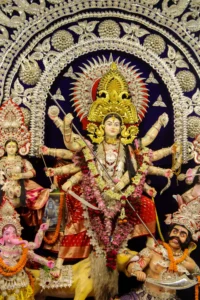
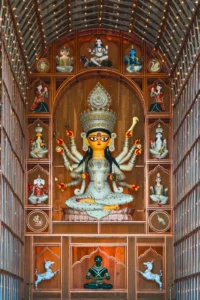
Durga‘s battle against the mighty demon Mahishasura in which she used her 10 hands, depicts her victory against Mahishasura, representing dharma’s triumphant victory over chaotic evil by divine power. Armed with her weapons the gods gave to her, Mother Durga on the lion went to defeat the buffalo demon Mahishasura along with her four children who were Ganesha – the remover of obstacles, Lakshmi – the goddess of prosperity, Saraswati – the goddess of wisdom and arts, and Kartikeya – commander-in chief of divine army.
Yet, Bengal’s Durga Puja, at one level, is more of a family-centered celebration than a fearful one. Durga is welcomed not only as a fierce warrior queen but also through names Uma or Gauri that represent the daughter returning to her maternal home after being with her wedded husband Shiva in Mount Kailash for a while. This emotion-oriented approach to the festival makes it a celebration of love and reunion.
Durga Puja is a massive, joyful, and culturally-rich festival event that brings people of the social and cultural milieu together. After the ancestral fortnight of the Pitri Paksha, the festival of Devi Paksha (the fortnight of the Goddess) commences during which the goddess is worshiped with great reverence. In 2021, UNESCO recognized Durga Puja of Kolkata as Intangible Cultural Heritage of Humanity and has established it as a festival which brings different traditions together in the streets- contemporary architecture, folk artwork, and ritualistic performances.
The Five Days Explained
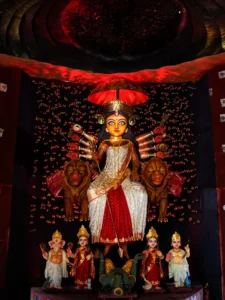
Maha Shashthi: The Arrival & Awakening
- The Worship: The ceremonies officially begin with Kalparamba, then Bodhon (the goddess is ceremonially woken under a wood-apple/bilva tree), Amantran (invitation), and Adhibas (purification). Then at last the idol face (pratima) will be unveiled to the public.
- The Atmosphere: Families wearing freshly bought attire are walking about looking expectant, fashion-forward, and full of excitement.
- What a Tourist Should Do: This one is the perfect late evening for taking part in a first-time pandal hopping session before the major crowds arrive.
Maha Saptami: Divine Herbs & Royal Blessings
- The Ritual: Before sunrise, Nabapatrika, a bundle of nine sacred herbs tied together and wrapped in a white saree with orange border, also called Kola Bou (banana bride) in the local lingo, is taken to the Hooghly River (Ganges) for a bath ceremony (snan) and afterwards kept close to Ganesha.
- The Mood: Lively and syncopated, with the sound of the dhak (huge indigenous drums) vibrating the whole neighborhood.
- What a Visitor Does: Go to Babughat or Bagbazar Ghat at 5:30 AM to see Kola Bou’s Bath and then wander around traditional old North Kolkata.
- Crowd Level: Very High; the streets continue to be busy even till 3:00 AM.
Maha Ashtami: The Pinnacle of Spiritual Life & Sandhi Puja
- The Ritual: The main event on the most sacred day would be Pushpanjali in the morning, devotional offering of flowers, in the form of Sanskrit followed by Kumari Puja, where a pre-pubescent girl, as a young girl, is worshipped as a living deity. This event is on a grand scale at Belur Math, the headquarters of the Ramakrishna Mission. It culminates in the electrifying Sandhi Puja where it is being done during a 48-minute juncture that perfectly separates the termination of an Ashtami from Navami. While the legend tells that the goddess has transformed into a fierce form called Chamunda to kill the demons Chanda and Munda, the priests light 108 earthern lamps (DIyas) and simultaneously 108 red lotuses are offered to the sound of crashing cymbals (kansora ghanta).
- The Mood: Very devout religious, nostalgic and a sense of grandeur almost every Bengali dressed in traditional handloom clothing.
- What a Visitor Does: See a Kumari Puja in the early hours of the day, enjoy the community lunch bhog, and be amazed during the evening Sandhi Puja aarti.
- Crowd Level: Extremely crowded; hundreds and thousands of people are simultaneously occupying the streets.
Maha Navami: The Sacred Fire & Dhunuchi Dance
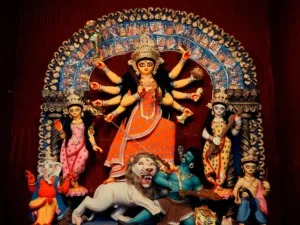
- The Ritual: The day sees Maha Navami Homa (a grand sacrificial fire) and the formal end of the main puja vidhi as its highlight. The evening marks the grand Maha Aarti, followed by the dhunuchi naach – an intoxicating ritual dance where the performers balance clay censers filled with fragrant frankincense, coconut and camphor in their teeth and hands, and perform to the sound of the frantic drums.
- The Mood: Carnival-like ecstasy intertwined with a lingering bittersweet awareness that the festival is nearly gone.
- What a Visitor Does: Have a lavish non-vegetarian Navami meal, catch dhunuchi naach performances in the neighborhood barowari pandals, and spend the entire night pandal-hopping.
- The Mood: Crowded beyond description; the city roads almost completely change their nature into vast pedestrian plazas before morning.
Vijaya Dashami: The Farewell, Sindoor Khela & Bijoya
- The Ritual: The final Devi Boron puja is offered by the married women to their Goddess, plus sweets and betel leaves with which they touch the feet of the Goddess. This will lead to Sindoor Khela wherein women smear red vermilion on each other’s face in a playful way and celebrate marital bliss as well as feminine power. In the late afternoon and evening, the immersion ceremonies (Visarjan) are done in grand musical processions at the river ghats after the idols are brought there.
- Mood: From the tearful good-byes, a transition into a joyful farewell is made as people remember the line “Aschhe bochhor abar hobe” (She will return again next year).
- What a Visitor Does: To enjoy the Sindoor Khela, you may attend one of the traditional pandals around 10:00 AM, hire a boat at Babughat or Princep Ghat to see the immersions, and give plates of mishti (sweets) for the Bijoya Dashami greetings.
- Crowds: The ghats along the river and the main roads will be very crowded.
Where to find the Most Impressive Pujas in Kolkata?
There are two separate groups of pandals in Kolkata from a philosophical perspective:
- North and Central Kolkata: These types of pandals are basically based upon heritage, have a classical look, use ek-chala idols, which means that all deities share the same background, and use very rich decorations in daker saj (a silver filigree and beaten sola pith).
- South Kolkata: These pandals are a hit because they focus on creative concepts, huge artistic themes, social critique, modern design, and lighting.
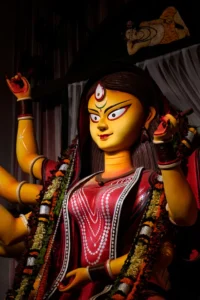
KOLKATA PANDAL GEOGRAPHY
| NORTH AND RIVERFRONT | CENTRAL HUB | SOUTH & SOUTH-EAST |
| Bagbazar Sarbojanin | College Square | Ekdalia Evergreen |
| Kumartuli Park | Mohammad Ali Park | Singhi Park |
| Ahiritola Sarbojanin | Santosh Mitra Square | Ballygunge Cultural |
| Sovabazar Rajbari | Suruchi Sangha | |
| Badamtala Ashar Sangha | ||
| Mudiali Club | ||
| Chetla Agrani |
Top 10 Must-Visit Durga Puja Pandals in Kolkata
| Pandal Name | Region | Nearest Metro | Iconic Highlight & Architectural Style |
| Bagbazar Sarbojanin | North Kolkata | Shayambazar | Century-old traditional ek-chala pratima, classic heritage carnival vibe. |
| Kumartuli Park | North Kolkata | Sovabazar Sutanuti | Artistic installations paying tribute to the idol-making potters of Kumartuli. |
| College Square | Central Kolkata | MG Road / Central | A monumental illuminated palace reflected over an iconic heritage lake. |
| Santosh Mitra Square | Central Kolkata | Central | Mega-budget thematic structures (replicas of world architectural wonders). |
| Ekdalia Evergreen | South Kolkata | Gariahat / Kalighat | Replicas of ancient Indian temples with world-famous German chandeliers. |
| Singhi Park | South Kolkata | Gariahat / Kalighat | Timeless pure-traditional idol artistry with intricate Chandannagar lighting. |
| Suruchi Sangha | South Kolkata | Majerhat / Kalighat | Cultural deep-dives recreating indigenous Indian state crafts and eco-art. |
| Chetla Agrani | South Kolkata | Kalighat / Rabindra Sarobar | Avant-garde art direction using natural materials and masterful clay work. |
| Mudiali Club | South Kolkata | Rabindra Sarobar | Mesmerizing geometric light tunnels and exquisite traditional idol sculpting. |
| Badamtala Ashar Sangha | South Kolkata | Kalighat | Pioneer of modern theme-based storytelling and experimental spatial design. |
For the complete list beyond these top 10, see our full Kolkata Durga Puja pandal list for 2026.
Planning Your Trip
Getting There
- Air: Kolkata is connected to other major cities of the world as well as the country through this airport. Flights to Puja week, a time of heavy demand for air tickets and a surge to about 150-200% of the base rate, should be booked at least three, five months ahead.
- Rail: Howrah, Sealdah, and Kolkata Terminal stations cater to super-fast trains running from different parts of the country. During that period, special Puja trains leave those stations; but, booking for the same opens 120 days before the train journey and sells out within minutes.
Where to Stay
- Luxury & Heritage: The Oberoi Grand (Esplanade), The Lalit Great Eastern (Dalhousie), ITC Sonar & Royal Bengal (EM Bypass), Taj Bengal (Alipore).
- Mid-Range & Boutique: The Elgin Fairlawn (Sudder Street), Kenilworth Hotel (Little Russel St), Peerless Hotel (New Market), Raajkutir – IHCL (Salt Lake).
- Budget Travelers: Guesthouses and boutique homestays around Salt Lake, New Town, and Ballygunge. Reserve rooms by June–July 2026. For a fuller comparison of neighborhoods and price bands, see our Kolkata hotels guide for Durga Puja.
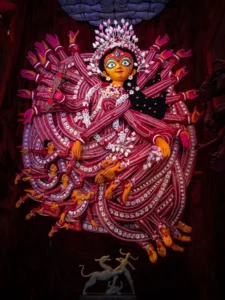
Metro & Local Transport in Kolkata
During Puja, the Kolkata Metro is the most convenient way to travel around the city.
North-South Route (Blue Line) connects smoothly the North Kolkata pandals (Shyambazar & Sovabasar) with central ones (MG Road & Central) and South Kolkata (Kalighat & Rabindra Sarobar). Howrah Station to Esplanade & Sealdah to Salt Lake/ Sector V (Green Line) along the Hooghly riverbed.
Their metro system operates night transit on Saptami Ashtami Navami evenings with the metro running almost non-stop till early morning hours i.e. around 4:00, 5:00 AM. Cars & Cab services (Uber/Ola) are the best option if you like flexibility and privacy. They function round the clock even at higher prices and are facing heavy traffic jams in the area. So it’s highly recommended to plan your journey in advance to avoid surge prices and traffic.
Package tours and Passes
West Bengal Tourism Development Corporation (WBTDC) has thoughtfully arranged tours by AC buses in the morning and night time covering both heritage household (bonedi bari) pandals and community (sarbojanin) ones. VIP passes (mainly through Sharad Samman awards via corporate) can be obtained via travel agencies, luxury hotel concierges or tourism websites for accessing the pandals bypassing the long public queues.
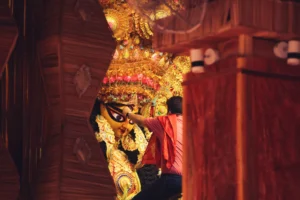
What to Pack & Weather Condition
In October, after the monsoon rains, the climate becomes transitional. Daily temperatures hover around 28-33C and the relative humidity is between approx. 70-80% whereas, in the later hours of the day, wind chills down the temperatures to about 22-25C. The things that you must have: comfortable light clothing made of cotton for summer weather, very comfortable supportive running/walking shoes (as you will cover 10-15km daily), rain cover for drizzles, small fan attachable to neck for air cooling, and a rugged daypack provided with anti-theft features like double locks, slash resistant, RFID blocking, invisible zippers to deter petty theft, etc.
What to Eat?
Durga Puja transforms Kolkata into a continuous 24-hour open-air restaurant. All kinds of strict diets will be thrown to the wind as eating at a restaurant for a treat is part of the fun. For the full day-by-day food breakdown, see our Durga Puja food guide for Kolkata.
- Community Bhog: At community pandals of Saptami and Ashtami, the community bhog is offered free of cost or through coupons. A representative meal has gobindobhog khichuri, labra (an assortment of chopped, cooked vegetables seasoned with a light mustard oil sauce), beguni (eggplant slices deep fried with a batter), date and tomatoes chutney (sweet), and payesh (sweet, spiced milk rice pudding).
- Street Food Trail: Go to the market stalls nearby the pandals where pandals have been erected for food like phuchka or golgappa (dipped in water then dipped in tamarund water, served as balls of chick pea batter filled with tamarind water) that are extremely tangy, churmur that is very hot, flakey Kolkata egg and mutton sandwiches (visit Nizam’s or Kusum Rolls), crisp fish fry (karil mackerel) served with pungent kasundi (yellow mustard paste), and layered Mughlai parathas.
- Navami Mangsho: The Bengali celebrate Maha Navami by cooking the delicious meat curry (kosha mangsho) of the goat accompanied with the puffed bread (luchi or the rice based dish called pulao). Go to traditional restaurants like Golbari (Shyambazar), 6 Ballygunge Place, Bhojohori Manna, or Kasturi, all of which are heritage places serving Bengali food.
- Bijoya Mishti: After Dashami, the festival is celebrated by feasting on sweets: dorbesh that is hot and soft, norom pak sandesh which melt-in-the mouth, pantua that is loaded with syrup, rajbhog, and clay pots of caramel-crusted mishti doi that are brought by old-style, time-tested sweet-making shops, such as KC Das, Balaram Mullick & Radharaman Mullick, and Girish Chandra Dey & Nakur Chandra Nandy.
What to Wear & Where to Shop?
One cannot talk about Durgotsav without talking about clothes: it is part and parcel of the festivity. People dress up in a different ensemble for each morning and each evening of the festival.
- Attire Rules in Mornings (Pushpanjali & Rituals): ethnic style. Ladies will be seen wearing handloom sarees (Taant saree, Dhakai Jamdani or Silk Tussar). Men opt for cotton or tussar kurta-pants combinations or kurta-dhoti.
- Nights (Pandal-Hopping): Indo-Western dress or ethnic dresses like linen shirts, ethnic maxi dresses, or fashionable fusion clothes with the comfort of sneakers.
Where to Shop (Pre-Puja Shopping Trail)
Marketplaces at Gariahat and Hatibagan are ideal for budget-conscious shoppers seeking various fashionable and reasonably priced clothes, terracotta accessories like rings and bangles, and various shoes at a fair price.
For traditional Indian attire such as silver jewelry, leather backpacks, and hand-woven fabric clothes, one can find a wide collection at Lindsay Street New Market, the historic colonial shopping center in Kolkata. It is a one-stop shopping destination.
Government-run shops from different states of India showcase their products at Dakshinapan Shopping Complex in Dhakuria. Here, the customers will get everything authentic from silk sarees to a wide array of handicrafts.
College Street is the perfect place for shoppers looking for the unique sola pith artworks and brass ritual items besides other handicrafts. For a deeper dive into prices and bargaining tips, see our Durga Puja shopping guide for Kolkata.
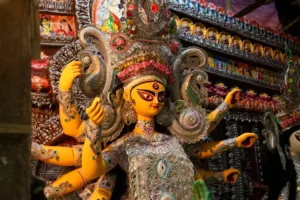
Beyond the giant Pandals
There is more in the story than only the pandals that are themed and make news on online media platforms. Inheritances of Bengali culture, courtyards with historical buildings, and local gatherings also reflect the soul of Bengali people.
Aristocratic Bari Bonedi (the pujas of Hereditary Courtyards of the Elaborate House) before neighborhood (barowari or sarbojanin) committees came into existence, it was the wealthy zamindar families who were the hosts behind the large-scale festival activities at open-air courtyards (thakur dalan).
- Sovabazar Rajbari: Established by the Raja Nabakrishna Deb and started the tradition of puja in 1757, it was historically attended by Lord Clive and Warren Hastings. The beautiful silver ornaments (daker saj) and the royal cannon firing during Sandhi Puja are its attractions.
- Sabarna Roy Choudhury Bari (Barisha): this puja which has a history of 402 years is one of the family pujas for landlords of the three villages that constitute Calcutta.
- Jorasanko Daw Bari: this is well-known for using gold and precious gemstones to decorate the deities.
Bengal Outside of Kolkata
- Chandanannagar (Hooghly): the place is famous for its giant light displays made of micro-LEDs, depicting scenes of animated storytelling.
- Bishnupur in Bankura: The Mrinmoyee temple here has witnessed 1,000-year-old traditional rituals carried out in the backdrop of historic terracotta structures.
- Rajbalhat & Guptipara: Discover a serene village fair where deity is worshipped in the open community fields near ancient riverbeds.
The Grand Durga Puja Carnival (Red Road)
This Durga puja carnival, an official state-sponsored event, will be held 2-3 days after Dashami and will be in a large area of Red Road adjacent to the Maidan. Over 100 puja committees that have won top awards in art and culture will be participating. Each committee will be putting on a show which will be the procession of massive idols on decorative floats and folk performances by hundreds of dhakis with musicians as they proceed.
The Sounds & Rituals You’ll Encounter
To experience Durga Puja is to be enveloped by a mesmerising tapestry of sounds, sights and smells:
- The Dawn Call of Mahalaya: On Mahalaya, at about four in the morning millions all over Bengal open their doors to listen to Mahishasuramardini, a classic All India Radio recording of the Chandipath performed and narrated by Birendra Krishna Bhadra, surrounded by the sound of a grand ensemble of instruments and devotional songs.
- The Rhythm of the Dhak: The enormous, feathered barrel drum that gets pounded out by the villagers, (dhakis), is not only the heart of our festival from the acoustic point of view but also gives the most basic sound.
- Dhunuchi Naach: People perform the Dhunuchi Naach carrying burning jhunas, i.e. clay pots mixed with resins such as sal and coconut husks which emit soot and thick, fragrant smoke as the dancers are moving in their trance of pleasure to thank the goddess.
- Kansor Ghanta & Shankha: Each and every aarti is marked by the very distinct sound of the hand-beaten bronze kansor ghanta ringing and deep conch Shankhas being blown.
- Agomoni Songs: Ancient 18th-century folk songs describing the tender conversations between Queen Menaka and her visiting daughter Uma.
First Time in Kolkata for Puja?
Crowd Safety & Movement
It’s very difficult (sometimes even impossible) to fight human barricades. The right thing to do is stay calm and move with the crowd.
You should carry the backpack not on the back but in front to help against pickpockets and snagging.
Finances & Connectivity
You will need some physical cash because sometimes UPI payments do not work. You can safely carry between 2,000 and 3,000 by breaking down the notes into 50 to 100 denominations.
Make sure your mobile phone is charged. A 20,000 mAh power bank is recommended as you will be shooting pictures, continuously searching through maps, and your phone battery will get drained at a very fast rate.
Hydration & Wellness
Only buy water from bottled brands or if it has a green coconut it must be fresh.
Public toilets will be available, but they will be very limited. So, it is a good idea to use toilets located at big shopping malls, the cafes of a hotel or the metro stations before getting in between the rows of street barricades.
Meeting Points
Before each pandal zone, your group needs to agree upon and identify a visible landmark outside where you can get back in touch once you run out of mobile network signals.
24×7 Emergency Helplines
- Kolkata Police General Emergency: 100 / 112
- Kolkata Police HQ Control Room (Lalbazar): 033-2214 5000 / 033-2214 3000
- Women’s Safety Helpline: 1091 (Toll-Free)
- Traffic Police Control Room: 1073 (Toll-Free)
- Child Helpline: 1098
- Medical Ambulance Emergency: 102 / 108
Event Highlights of Durga Puja 2026 in Kolkata
- Clay Art Walk of Kumartuli: Stroll along the small streets of the potter district of North Kolkata and witness how these potters are transforming clay and straw into beautiful forms with some mud from Hooghly and some pigments.
- Dawn of Mahalaya at Babughat (10 October 2026): thousands come to offer themselves up in the form of water from the holy riverfront and they also listen to the morning broadcasts at the same time.
- Kumari Puja at Belur Math (19 October 2026, 9:00 AM): The one and only most spiritual ceremony in Kolkata will take place in the vicinity of Howrah, opposite the river.
- Babughat Immersion Cruise (21-22 October 2026): take a speed boat or a wooden boat (from Princep Ghat) to enjoy seeing the underwater immersions of idols which are going on from hundreds of houses on land.
- Red Road Carnival of Kolkata (23/24 October 2026): The colorful finale of the festival with the display of hundred best idols and cultural troupes from across Bengal.
Frequently Asked Questions
1. When is Durga Puja in 2026?
Durga Puja of the year 2026 is going to be held officially from Friday, 16 October, (Maha Shashthi) to the day of the festival Wednesday, 21 October, (Vijaya Dashami). Mahalaya will take place the day after that is Saturday, 10 October.
2. Why does Durga Puja have two Saptami days in 2026?
Since the lunar calendar, Saptami tithi (day segment) starts from Saturday, 17 October in the morning and goes on till Sunday, 18 October covering two consecutive calendar days across different traditional panjika (calendar) systems.
3. How many days is Durga Puja celebrated?
Religious rituals of Durga Puja are mainly celebrated in five days (from Maha Shashthi to Vijaya Dashami). Festivities, food carnivals, and pandal hopping with illuminations though can extend from almost 10-12 days of the entire state.
4. Which is the best day to visit pandals in Kolkata?
The finest period for the pandal viewing is Maha Shashthi i. e. 16th October, followed by the evening celebration of the first Maha Saptami, that is, 17th October, where freshly unveiled pandals can be seen while crowds are not yet too dense and it is before the festival reaches peak congestion.
5. Is Durga Puja a public holiday in West Bengal?
In fact, West Bengal has extended holidays including the state government banks, schools, and corporate from Tritiya/Chaturthi to Vijaya Dashami and also include weekends immediately after the Puja festival.
6. Which is the oldest Durga Puja in Kolkata?
The earliest family puja was the Sabarna Roy Choudhury family, Barisha (begun in 1610); the oldest public community Sabarna Roy Choudhury puja is Bagbazar Sarbojanin (begun in 1919).
7. Can non-Bengalis and non-Hindus visit pandals?
Yes, Durga Puja in Kolkata is open secular, multicultural, inclusive. Ideology based. No matter what your nationality, ethnicity, religion , caste, creed or language, you will be allowed to enter any Pandali.
8. What should I wear to a Durga Puja pandal?
No specific religious dress code is required for public viewings, but modest clothes and comfort-oriented clothes are recommended. When on the active pandal trail, it is suggested to wear light cotton fabrics and walking sneakers.
9. What is the expense of a Durga Puja visit to Kolkata?
Packages offering five days in the city start between INR 15,000-25,000 for someone who plans on staying in hotels and using the metro transit only for getting around to the places. The cost of luxury holidays, staying in 5-star properties and traveling via hired private vehicles would be INR 50,000-1 20 000+ per person.
10. Does Metro continue running till all hours during Durga Puja?
Kolkata Metro Rail Company generally organizes additional train runs on both Blue and Green lines on Saptami, Ashtami, and Navami nights for very late hours until early morning hours.
11. What is Sandhi Puja and is it that important?
During Sandhi Puja, the exact 48-minute overlap between Ashtami and Navami is honored. This marks Goddess Durga’s incarnation as Chamunda when she defeated the demon generals Chanda and Munda.
12. Where does the immersion of the idols happen in Kolkata?
The major idol-immersion spots are on river Hooghly’s banks at Babughat, Bagbazar Ghat, Judges Ghat, Baje Kadamtala Ghat and Nimtala Ghat, which are managed through strict environmental protocols by Kolkata Municipal Corporation and Kolkata Police.


