Baisipalli Wildlife Sanctuary falls wholly within Nayagarh district and is seldom mentioned outside unique wildlife enthusiasts’ circles in Odisha; it is often fairly overshadowed by the more well-known Satkosia Tiger Reserve and simply regarded as the quieter constituent. For the visitor researching Baisipalli Nayagarh as a wildlife destination or having a trip comparison of it with the more renowned parks in Odisha, here is the lowdown.
About the Baisipalli Wildlife Sanctuary
Baisipalli Wildlife Sanctuary was formed on 6 May 1981, on 168.35 sq. km. of all dry & moist peninsular Sal forest, completely in Nayagarh district. Directly to the south of the more ancient Satkosia Gorge Wildlife Sanctuary (forms in 1976), the two were integrated to become the Satkosia Tiger Reserve in 2007 so whenever you read about “Satkosia” you are reading about a reserve that encompasses Baisipalli, not a separate place. Baisipalli takes its name from the 22 habitats, or settlements, it contains, which also accounts for why some of the reserve seemed more populated than a strictly protected core zone.
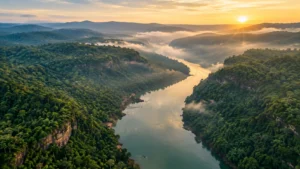
Baisipalli lies within the Eastern Ghats sub-division and the Deccan Peninsula Biogeographic Zone, where two of India’s three main bio-geographic regions meet. This is a significant reason for the rich diversity of animals in this relatively small area. The elevation varies from close to sea level to about 900 metres above sea level. The sanctuary edges the Mahanadi Gorge and Satkosia gharial conservation area in the north.
Baisipalli, although less bothered than most Odisha protected areas, is still a good example of what visitors are referring to when they say Odisha wildlife sanctuary experiences outside the state’s famous destination, Similipal – fewer tourist numbers, quite a typical river-gorge situation, and partly dry Sal jungle combined with river edge in a smallish area.
Wildlife inside Baisipalli Sanctuary
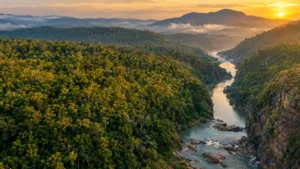
Baisipalli’s forest cover is dominated by Sal (Shorea robusta) alongside riverine forest along the Mahanadi’s edge, and the wildlife list reflects that mixed habitat:
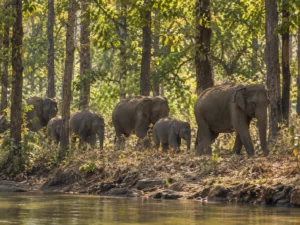
Elephants – a resident population moves through the sanctuary and the wider Satkosia landscape
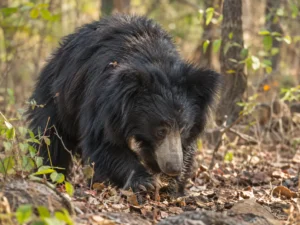
Sloth bears
Leopards
Tigers – present as part of the wider Satkosia Tiger Reserve, though sightings anywhere in this landscape are uncommon; this is a forested, riverine terrain rather than open grassland, so patience matters more than luck
Sambar deer and spotted deer (chital)
Chousingha (the four-horned antelope), a herbivore species more specifically associated with this part of Odisha
King cobra and python, along with other reptile species typical of Sal forest
Gharial and mugger crocodiles, concentrated along the adjoining Mahanadi Gorge rather than deep inside Baisipalli itself
Water birds, drawn to the river system, with migratory species adding to the count in winter
Two dedicated wildlife centres are located inside or nearby Baisipalli: the Kuturi Deer Park and an elephant rescue and rehabilitation centre to the northwest, which is just worth including in a trip if your main interest is not in seeing animals in the wild but in conservation work.
Best Time for Safari
November through April is the standard recommendation, and for good reason: it is cooler, drier, and likely to have the best animal movement along watercourses and forest roads. Others cite September and October directly after the monsoon as being a popular time for birding and overall animal sightings but note this coincides with the reserve’s off-season (as Satkosia’s parks generally close for the monsoon from mid-May to most of October). Contact the forest department directly to confirm current opening dates before planning an early season visit; do not assume the reserve will be open in September or early October.
If heat affects you, steer clear of the high summer months (say, April into May). Days get quite hot in this part of Odisha, though the dry heat may at times push wildlife to the reduced water sources.
Permits & Entry to Baisipalli Sanctuary
Entry to Baisipalli and the other Massipalli of the Sat Kosia landscape was only possible with permission; this is a protected forest and wildlife area, not a national park accessible to the general public.
Where to obtain permits: Tourist and entry centres can be found at a number of locations, like Pampasar, Kusanga, Chhamundia and on the Badamul (Nayagarh-side) approach; the entry permits are often issued on the spot at the checkpoint. As this can vary greatly from entry point to season, get the current process for whichever route you are using before you leave.
Identification needed: To prove they are Indian, Indians would generally need a photo ID such as a PAN card or a driving licence. For foreigners, one would need passport details.
Overnight stays are possible, but you would need to obtain permission from the Mahanadi Wildlife Division DFO (Goda) beforehand (it is not possible to book on the day of arrival, so if you wish to stay overnight in the sanctuary then it must be planned as a result).
Vehicles: most safaris occur in visitors’ own vehicles rather than a ‘fleet’ of vehicles owned by the department. This is a significant feature of less managed parks elsewhere in India but something to bear in mind when planning your own transport.
Entry and camps: entry and camp fees are relatively low compared to those charged in a national park (for example, the nature camp at Tikarpada, not far from here, charges around 40 rupees per head per day for entrance in the reserve, excluding accommodation), but current fee structures should be checked with the forest department rather than from outdated websites.
Frequently Asked Questions
1. Where exactly is Baisipalli Wildlife Sanctuary located?
Located completely in Nayagarh district, Odisha, just south of the Satkosia Gorge Wildlife Sanctuary; the closest airport is Bhubaneswar, and the nearest railway station is at Khurda Road.
2. Is Baisipalli the same as Satkosia?
Not quite. Baisipalli and Satkosia Gorge Wildlife Sanctuary are actually two distinct adjoining protected areas which were merged at the administrative level in the Satkosia Tiger Reserve in 2007. Baisipalli is the southern-Nayagarh side part of this combined reserve.
3. Can I see tigers at Baisipalli?
The tiger is also found within the larger part of this tiger reserve, the Satkosia Tiger Reserve. Though this is a thick group of woodland along the river- based areas, these tigers are very rare; the chances of seeing these tigers are also reduced. Please experience the different aspects of the other wild and natural settings outdoors rather than seeing these tigers.
4. What permits do I need to enter?
Access permission in advance from the district commissioner is preferable; it can be collected from the CPZ checkpoint and anytime from Badamul (Kusanga or Chhamundia checkpoint) and other 4 operation checkpoints. For Indian national photo ID is preferable (PAN card or driving licence), and for foreign national passport details are required.
5. When is Baisipalli closed to visitors?
The reserve is generally closed during the southwest monsoon, about mid-May to about late October, but the dates vary each year slightly, so check with the forest department.
6. Can I stay overnight inside the sanctuary?
Yes, possible at places such as the Kuanria Forest Rest House, but only with prior permission from the DFO, Mahanadi Wildlife Division, not for same-day trips.
7. How far is Baisipalli from Bhubaneswar?
Approximately 100-130 km, as the entry point selected with the nearest airport and main transportation link for the entire Satkosia landscape being Bhubaneswar.