
Nestled between two hills in central Odisha, Nayagarh town may be a quick zip as you head off towards Satkosia and Baisipalli, but Nayagarh town’s history deserves a stop all of its own. It is the capital of a former princely state, has a temple constructed in the late 1700s, and, by geographic quirk, and is a town that survived one of the deadliest cyclones in India’s history almost unscathed.
Origin of Nayagarh Town
Nayagarh was founded in the 13th century by King Suryamani of the Baghela dynasty, who travelled to Puri, coming over from Rewa and established a kingdom here. The real origin of the name “Nayagarh” is from the Baghela dynasty’s ninth king, Bagel Singh, who moved the capital and named it Baghua Nayagarh, after which the modern name is derived.
Nayagarh stands at an altitude of approximately 178 metres (584 ft) above mean sea level at 20.13°N 85.1°E and today functions as both a town and the municipal and district headquarters of Nayagarh Odisha a role it inherited from its centuries as the seat of one of the district’s four former princely states (the others being Ranpur, Khandapara, and Daspalla). The population of Nayagarh town, as per the 2011 census, is a mere 17000, a small growing town, thanks to its status as an administrative and religious centre today.
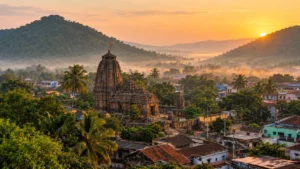
Jagannath Temple Nayagarh
The town’s identifying feature is the Jagannath Temple Nayagarh built between 1788 and 1808 in the traditional Kalinga style just about two and half centuries after the town was established. The main deity worshipped here is Dadhibamana, which is a regional variant with Kutabli in the broader Puri Jagannath culture.
The location is also part of what makes the temple unique: Nayagarh’s two hills, Rukhi to the south and Balaram to the north, and the temple sits in between. Just a little way off, a Dakshina Kali temple regarded as of the “living” Shakti Pitha, with the temple of Gopinath across the road together making one of the synagogues of temples that pin the town in its religious world. For visitors, a journey to Nayagarh from other places in the district, the Raghunathjew Temple at Odagaon or the Nilamadhaba at Kantilo begins with the Jagannath Temple.
Role in the 1999 Cyclone
This is the more detailed account that most travelers never get to hearand it’s a pretty fascinating story: on 29 October 1999, the 1999 Odisha Super Cyclone hit the coast of Odisha in India with sustained wind speeds of close to 260 km/hr, claimed nearly 10,000 lives and caused severe damage to the coastal districts of Balasore, Bhadrak, Kendrapara, Jagatsinghpur, Puri and Ganjam, Nayagarh town escaped comparatively lightly. Why was it fortunate? From Wikipedia, the cyclone did not hit the heart of the town. It was the Rukhi hill, which is to the south, and Balaram hill on the north side there which protects the town of Nayagarh from the cyclone winds.
Essentially, the same topography that offers Nayagarh picturesque temples proved itself as a natural protection against the cyclone, which was one of the most extreme weather events ever encountered in the Indian subcontinent (now one of the most deadly, only ever exceeded in North Indian Ocean history by the 1970 Bhola storm in East Pakistan). It is a minor detail in the wider history of the 1999 cyclone, but one that is of particular local interest when studying the town outside of temples.
New Jagannath Sadak Road
Along the border of Nayagarh runs a segment of the New Jagannath Sadak (otherwise known as the Nua Jagannath Sadak). This 96-kilometre road links Nayagarh to the holy city of Puri, home to the original Jagannath Temple. The road’s short name and construction history suggest defensive and pilgrim-route origins, with a roadway that once enabled travel from inland Odisha toward the coast and still connects Nayagarh town to Odagaon and, ultimately, Puri district.
For the traveller, this road is useful too, apart from being of historical interest, as it helps to make possible a combined itinerary of Nayagarh town and a broader Odisha pilgrimage route, which is more than a single-place drop.
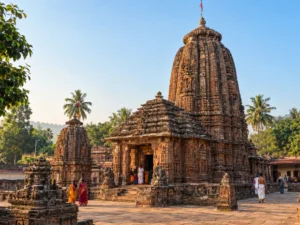
Local Markets Nayagarh
The economy of Nayagarh is mainly based on agriculture and local trade and the general stores in the town that supply those needs do so in the nature of small personal vendors and traders, not a major commercial hub. Nayagarh has still established itself in wider regional consciousness on another front–as the home of chhena poda the baked cheese based desert that is a household name in Nayagarh district and a number of places across the state. As per local stories the sweet was discovered by accident between 1940 and 1945 by a sweet-maker from Daspalla in Nayagarh district Sudaresh Sahu, who left a mixture of chhena, sugar, and semolina overnight in a warm oven so that it all became baked and cooked. By morning it turned to a new sweet, a new fat caramelized food. The dessert has traveled beyond Nayagarh to become one of the more popular desserts in Odisha – one that is currently being suggested for a GIthe first in the stateto be associated officially with the district in which it hails from.
Chhena poda may be available in sweet shops of Nayagarh town as well as the district; if you happen to be in the town markets sampling the vegetable, fruit and household-goods trade there during daily life, it is a remarkably natural (and tastiest) snack to add while picking up supplies; anyone booking a trip to the district temples or wildlife sanctuaries would have to suggest stopping in a snack stop for such at least once or twice.
Frequently Asked Questions
1. How old is Nayagarh town?
The town has royal origin in the 13th century when the Baghela King Suryamani established a kingdom there. The present name is derived from the 9th Baghela King Bagel singh (1480-1510).
2. Why is Nayagarh town a renowned name?
Its sources of fame are the Jagannath Temple (1788-1808), the former hilltop administrative seat, and environs, the Rukhi and Balaram hills that border the town and, on the regional scale, the marriage dessert chhena poda.
3. Which god is worshipped at the temple of Nayagarh?
The idol is worshipped as Dadhibamana, a local incarnation of the Jagannath in the state at Puri.
4. How badly did the Super Cyclone of 1999 affect Nayagarh town?
Not very. Although it devastates districts along the coastline, the town was relatively unaffected because the Rukhi hill to the south and the Balaram hill to the north are said to have helped protect it.
5. What is the New Jagannath Sadak?
96 km road (also known as the Nua Jagannath Sadak) connecting Nayagarh to Puri travel- history pilgrims and today a continuing route for journeys linking Nayagarh to the broad Odishan pilgrimage circuit.
6. Is it really from Nayagarh town?
The dish is popular in the whole Nayagarh district and all origin stories relate to the accidental invention of chhena poda in the district wide Nayagarh town of Daspalla, sometime in 1945.
7. How far is Nayagarh town from Bhubaneswar?
Roughly 88-90 km by road, about a 2 to 2.5 hour drive.
8. Would you recommend staying in Nayagarh town as a convenient starting point for touring the district?
Yes, central in the district, and with good road links (including the New Jagannath Sadak), this would be convenient for Odagaon Kantilo Satkosia Gorge and the Baisipalli Wildlife Sanctuary.


