
The Raghunathjew Temple is situated in Odagaon village, Nayagarh district, Odisha. It is about 26 km from Nayagarh town. This is an active Vaishnav temple, a genuine place of worship with actual history. Not something built just for tourists. The deities here don forest-exile dress. The three kalashas on top contain 45 kg of gold total. And the grounds have a connection to the 17th-century poet Upendra Bhanja.

Quick Facts
| Attribute | Value |
| :— | :— |
| Location | Odagaon, Nayagarh district, Odisha |
| Presiding deity | Raghunath (Rama), with Sita and Lakshman |
| Idol material | Neem wood |
| Deity attire | Van Vasa (forest exile dress) |
| Architecture | Kalinga style, three mandaps |
| Gold kalashas | 3 kalashas, 45 kg total |
| Main festival | Ramanavami Yatra, 9 days, Chaitra (March/April) |
| Distance from Nayagarh town | 26 km |
| Distance from Bhubaneswar | 110–115 km |
What Is the Raghunathjew Temple in Odagaon?
It is a Vaishnav temple devoted to Lord Raghunath, another name for Rama. It is a functioning shrine. There is a resident deity cluster, daily worship occurs, and an annual festival cycle operates smoothly.
Where Is the Raghunathjew Temple Located?
The temple stands in Odagaon village. That is in Nayagarh district, central Odisha. Odagaon is situated 26 km from Nayagarh town. It is 110–115 km from Bhubaneswar. The New Jagannath Sadak, the historic road between Odisha and Puri, runs directly through the village. You actually drive past it.
Who Is the Presiding Deity of the Temple?
Lord Raghunath, the Rama form of Vishnu, is the main deity. Sita and Lakshman stand beside him. The three images constitute the primary worship ensemble inside the sanctum.
Raghunath, Sita and Lakshman Idols
Local accounts say the idols are hewn from neem wood. Raghunath sits in the centre. Sita and Lakshman are the two accompanying figures.
Why Is the Raghunathjew Temple Unique?
Three things distinguish it. The deities dressed in Van Vasa attire. The 45 kg of gold on the kalashas. And a documented tie to the poet Upendra Bhanja.
What Is Van Vasa Dress and Why Are the Deities Dressed in It?
Van Vasa is the simple clothing Rama, Sita and Lakshman wore during their 14-year forest exile. The temple dresses all three deities in this attire. It is an intentional, unique custom.
Van Vasa vs. Abhishek Vesa in Other Rama Temples
Most Rama temples in India deck their deities in Abhishek Vesa. That is the royal coronation dress. Odagaon instead depicts Rama as the exiled prince. This distinguishes its iconography from those other temples.
How Much Gold Do the Temple’s Kalashas Hold?
The temple’s three gold kalashas total 45 kg in weight. Kalashas are the pot-shaped finials atop the temple’s spire.
Gold Holdings Compared with the Puri Jagannath Temple
Local sources place this gold reserve second in Odisha. Right behind the Puri Jagannath Temple, the state’s holiest Vaishnav shrine. This ranking stems from local accounts. There is no independent documented confirmation for it though.
What Is the Architecture of the Raghunathjew Temple?
The temple adheres to the Kalinga architectural tradition. It is constructed in three linked sections. The structure guides devotees from the outer hall to the inner sanctum.
What Is Kalinga Style Architecture?
Kalinga style is the classical temple architecture of Odisha. It structures a temple as a series of linked halls leading to the sanctum. It is the design seen in Odisha’s older temples.
What Are the Three Mandaps of the Temple?
The temple has three mandaps: Bhadra Mandap, Nata Mandap and Darshan Mandap. They link in order from the outer hall to the inner sanctum.
Bhadra Mandap
The Bhadra Mandap is the outermost hall. It is the initial hall a visitor encounters.
Nata Mandap
The Nata Mandap is the central hall. It connects the outer hall to the sanctum entrance.
Darshan Mandap
The Darshan Mandap is the hall closest to the inner sanctum. This is where worshippers glimpse the deities.
When Was the Raghunathjew Temple Built?
The establishment date is contested. Three versions exist. A 1763 construction. A circa 1903 finishing. And an ancient origin with repeated rebuilding. No source gives a conclusive original date.
Is the Temple Dated to 1763 Under King Mrityunjay Singh?
One widely repeated tradition credits Mrityunjay Singh, the 19th king of Nayagarh, with building the temple in 1763. This account attributes the founding to royal patronage.
Is the Temple Dated to c. 1903?
The government tourism page dates the temple’s finishing to circa 1903. This date probably indicates a major rebuilding rather than the original founding.
Is the Temple an Older Structure Rebuilt Over Centuries?
The most credible version suggests that the temple is older than both dates. It was renovated repeatedly across centuries. Under this reading, the current structure is the 1903-era reconstruction of an ancient temple.
What Is the Mythological and Literary Significance of Odagaon?
Odagaon carries a mythological association and a literary one. Local legend links the site to the sage Atri Muni. Tradition links it to the poet Upendra Bhanja.
What Is the Link Between Odagaon and Atri Muni’s Yagna Kunda?
Local legend marks the temple site as the Yagna Kunda, the fire altar, of the sage Atri Muni. This association lends the site spiritual significance apart from the temple building.
How Is Upendra Bhanja Connected to Odagaon?
Upendra Bhanja, an esteemed 17th-century classical Odia poet, is thought to have used Odagaon as his Sadhana Pitha, his center of spiritual practice. Tradition attributes two accomplishments here.
Baidehisha Vilas
Bhanja is believed to have penned his Baidehisha Vilas at Odagaon. It is a composition in the Rama narrative tradition.
Rama Taraka Mantra Sadhana
Local legend states Bhanja undertook his Rama Taraka Mantra Sadhana at the site to achieve spiritual perfection.
Which Shrines Are in the Raghunathjew Temple Complex?
The complex houses six supplementary shrines around the main temple. This makes Odagaon a shrine complex rather than a single-deity site.
Durga, Narsingh, Navagraha, Surya, Ganesh and Narayan Shrines
The encircling shrines venerate Maa Durga, Sri Narsingh, the Navagraha (the nine planets of Hindu astrology), Surya (the Sun), Ganesh and Narayan. Together they broaden a visit beyond mere Rama worship.
What Festivals Are Celebrated at the Raghunathjew Temple?
The temple’s main festival is the Ramanavami Yatra. A nine-day observance of Rama’s birth. It features the Ravan Podi rite.
What Is the Ramanavami Yatra?
The Ramanavami Yatra is a nine-day festival commemorating Rama’s birth. Observed in the Hindu month of Chaitra (March/April). It attracts villagers and visitors from distant areas. Includes traditional stage performances and special pujas.
What Is Ravan Podi?
Ravan Podi is the burning of an effigy of Ravan during the festival. It symbolizes the triumph-of-good-over-evil theme common to Dussehra observances across India.
How Can You Plan a Visit to the Raghunathjew Temple?
A visit necessitates a private vehicle. You need to choose timing around Ramanavami. And be aware of scarce local facilities. The following sections address routes, seasons and nearby sites.
How to Reach Odagaon
Odagaon is accessed by road. Private car or taxi is the viable option. District-level public transport is sparse.
How Far Is Odagaon from Nayagarh Town?
Odagaon is 26 km from Nayagarh town. That makes Nayagarh the closest district center.
How Do You Travel from Bhubaneswar to Odagaon?
Odagaon is 110–115 km from Bhubaneswar via road. A journey of roughly 3.5 hours through Nayagarh town. A day trip is doable.
Distance and Drive Time
The route spans 110–115 km. Requires roughly 3.5 hours.
Route via New Jagannath Sadak
The New Jagannath Sadak, the historic Odisha–Puri road, passes through Odagaon. It serves as the easiest access route.
Why Private Car or Taxi Is Preferred
Public transport in the district is poor. So a private car or taxi provides the most dependable access.
What Amenities Are Available Near the Temple?
Odagaon has a Community Health Centre and a State Bank of India branch. Both are helpful for solo travelers.
Community Health Centre (CHC)
The CHC offers basic public healthcare in Odagaon.
State Bank of India Branch
The SBI branch provides access to banking facilities in the village.
What Is the Best Time to Visit?
The best time hinges on the experience desired. Ramanavami provides the complete festival. November to April offers pleasant weather and calmer temple access.
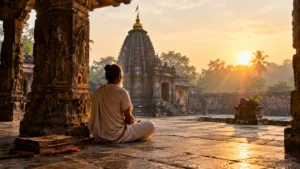
Is Ramanavami (March/April) a Good Time to Visit?
Ramanavami is the ideal time to witness the temple at its liveliest. The nine-day festival brings performances, crowds, and the full slate of pujas. It makes the village significantly busier. The 2026 festival has passed. The next falls in March/April 2027. So verify the precise date locally before traveling.
Which Months Are Best for Weather (November–April)?
November to April is the most pleasant travel period in this part of Odisha. It sidesteps peak summer heat and monsoon harm to rural roads.
Is Odagaon Worth Visiting Outside the Festival Season?
Odagaon is worth a visit year-round. The Kalinga architecture, the shrine grouping and the Upendra Bhanja connection endure. Non-festival visits provide a calmer experience.
What Other Vaishnav Sites Can You Visit Near Odagaon?
Two Vaishnav sites in Nayagarh district complement Odagaon well. The Nilamadhav Temple at Kantilo. And the Fategarh Ram Mandir.
Nilamadhav Temple, Kantilo
The Nilamadhav Temple at Kantilo is an age-old Vaishnav temple. Pairing it with Odagaon forms a richer Vaishnav circuit in Nayagarh.
Fategarh Ram Mandir (Mini Ayodhya)
The Fategarh Ram Mandir is a recent Rama temple in Nayagarh district. Known as Mini Ayodhya. It fits Rama devotees expanding their itinerary.
Frequently Asked Questions
Why Is the Raghunathjew Temple Famous?
The temple is renowned for its 45 kg of gold kalashas. Its Van Vasa-dressed deities. And its connection to Upendra Bhanja and the Baidehisha Vilas.
When Was the Raghunathjew Temple Built?
The building date is contested. 1763 under King Mrityunjay Singh. Circa 1903 according to the government tourism page. Or ancient origins reconstructed across centuries.
What Is the Main Festival at the Temple?
The Ramanavami Yatra. A nine-day festival honoring Rama’s birth. Featuring traditional performances and the Ravan Podi rite.
How Do I Reach Odagaon from Bhubaneswar?
Follow the road via Nayagarh town. 110–115 km and about 3.5 hours via private car or taxi.
Is the Temple Worth Visiting Outside Ramanavami?
Yes. The architecture, shrine grouping, and literary heritage render any season worthwhile. With thinner crowds beyond the festival.


