
Twenty minutes from Nayagarh town along the Kantilo road is Khandapara, a small town that was a principality in its own right until 1948. While most travellers who come to Khandapara Nayagarh flock to its one palace and temple complex, its history goes much further back, to the very foundation of Nayagarh, and the town was also the birthplace of one of Odisha’s most renowned scientists.
History of Khandapara State
This is more family history than political history. Odisha District Gazetteer states that the origin of Khandapara is more of family history than of political history. When the King of Nayagarh, Raghunath Singh, was dividing his estate at the end of his reign, the elder son, Harihar Singh, got Nayagarh itself, but Jadunath Singh, his younger son, got four garhs (forts or land holdings) named Kadua, Ghuntasahi, Saradhapur, and Khedapada. That was Khandpara State, built up by individuals of the family, which was formally constituted as a State in the year 1599. Its neighbour Ranpur, another of the district’s four princely states, has an equally interesting royal history. It is supposed that Jadunath Singh received the title of ‘Mangaraj’ from Gajapati Maharaja of Puri.
The state continued to expand over subsequent generations: by the rule of Raja Narayan Singh Mangaraj, the state’s borders stretched eastward to Banki, westward to Balaramprasad in the Daspalla hills, northward to Kantilo, southward to Jogiapali, and its northern frontiers defined by the course of the Mahanadi River. It is curious to note that although the administrative centre was located in Khandapara (‘Khandapada’ in contemporary publication), the state’s most important town was Kantilo, home today to the Nilamadhaba Temple on the banks of the Mahanadi, which the high volume of visitors tend to associate with Nayagarh district in general rather than with its history as the municipal hub of a once-aspiring dynasty, none of whose rulers ever seem to have been thrown alive into the Abhaya River.
Like its entire neighbouring Nayagarh State, the royal family of Khandapara also had the tiger’s head as its sign, a detail the two states shared, indicating their common Baghela-dynasty stock. This state, with others, was a princely state under the Eastern States Agency in the British Raj in the pre-independence days, covering a territory of about 632 km and consisting of a population of about 78,000 in 1901. The last ruler (1941-1948) signed the instrument of accession to the Indian Union on 1 January 1948, and during the post-independence era the former state was merged with the newly formed Nayagarh district in 1993 and the other three sister states of Nayagarh, Ranpur, and Daspalla. A recent (20th-century) Raja Saheb of Khandpara was elected as the MLA from the Khandapara assembly constituency in the 2009-2014 Odisha Assembly.
Yet, the most famous personality of Khandapara isn’t a king either. The town was born to Mahamahopadhyaya Chandrasekhara Singha Harichandana Mahapatra Samanta– popularly called Pathani Samanta, an almost entirely self-educated astronomer of the 19th century. The Siddhanta Darpana of his time is still acclaimed for its extraordinary correct projection of astronomical calculations on the basis of the best instruments. The figure of the great Indian scientist Pathani Samanta is still remembered as ‘Pathani Samanta Degree College’ in Khandapara.
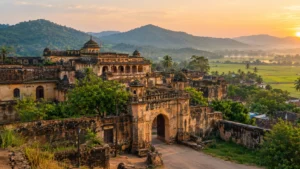
Places to See near Khandpada
- Khandapada Palace (Rajabaati): The state capital of the Khandapara kings. A rather modest royal palace, which is representative in style of the smaller princely states of Odisha. Now a historic monument.
- Jagannath Temple, Khandapada: Situated in the palace grounds, this temple is open from 6 AM till 9 PM every day. This temple is quite different from the more popular Jagannath Temple in Nayagarh town, and adheres to the same general contemporary tradition of devotional worship.
- Kantilo Nilamadhaba Temple: This Vaishnav temple on the banks of the Mahanadi is just 12 km from Khandapara town (similar distances to Nayagarh town, 100 km to Bhubaneswar), but it was the commercial centre of the Khandapara State. Quite close to Khandapara and ruled by the same dynasty, it’s worth extending an excursion there.
- Pathani Samanta Degree College: Not a conventional tourist stop, but a point of local pride worth knowing about if you’re interested in Khandapara’s connection to Odisha’s scientific heritage.
How to Reach Khandapara?
- By road: around 19 km away from Nayagarh town and approximately 85 km away from Bhubaneswar. It is a simple driving journey on district connectivity roads. If you are visiting or going around Nayagarh district, it can be taken as a small detour.
- By rail: there are no railway stations very near Khandapara in town. The closest railway station is at Nayagarh Town (nearby), which is 17 km from Khandapara.
- By bus: The town of Khandapada has a self-contained bus stop located approximately 7 km outside the palace complex. This bus stop serves routes to Nayagarh and beyond.
- From Bhubaneswar airport: Biju Patnaik International Airport is the practical air access for the entire district. Khandapada can then be reached on the road through Nayagarh town.
Khandapara functions best as a brief side trip to a larger trip of the entire Nayagarh district make it part of a trip to Nayagarh town itself to see its own Jagannath Temple, the Kantilo Nilamadhaba Temple, the Raghunathjew Temple of Odagaon itself if one has the time, all of which are a manageable circle on the district roads.
FAQ
1. What was Khandapara State?
A former princely state in today’s Nayagarh district, Odisha, founded in 1599 by Jadunath Singh Mangaraj, the second son of the King of Nayagarh. It acceded to the Indian Union on the 1st January 1948.
2. How is Khandapara related to Nayagarh State?
They have a common origin: Khandapara was extracted from the estate of a King of the Kingdom of Nayagarh, who gave his estate to his children, and the younger son inherited Khandapara. The royal families of both used the tiger’s head in his family symbol.
3. What is Khandapara famous for today?
The Rajabaati, the prominent Jagannath Temple, has a historical connection with the putative Kantilo Nilamadhaba Temple and, more eminently, as the origin of the 19th-century astronomer Pathani Samanta (famous for the Siddhanta Darpana).
4. How far is Khandapara from Nayagarh and Bhubaneswar?
Approximately 19 km away from Nayagarh town and 85 km away from Bhubaneswar.
5. Is there a railway station in Khandapara?
No, there is an even nearer station at Nayagarh Town, about 17 km away. The best way to get to Khandapara is by road.
6. What are the temple timings at Khandapada Jagannath Temple?
Open daily from 6 am to 9 pm (but see locally if you’re visiting for a festival/events).
7. Can Khandapara be combined with other Nayagarh attractions in one trip?
Yes, it is located near Kantilo Nilamadhaba Temple and is a feasible sidetrack from Nayagarh town, allowing for a day trip with the rest of the district’s temples.


