
Odisha is really one of the most underrated states in India. It’s not that people don’t know this place, it’s just that they have so much to offer and nobody advertises it. It has so much interesting history to explore that nobody outside the state has heard of, and Ranpur fits the definition perfectly. It is a small quaint town in Nayagarh district, once the seat of a princely state old enough to trace its rulers back to the Solanki Rajput lineage, and still carrying the nickname “dwitiya Shreekhetra” the second Puri because of how seriously they take the worship of Jagannath.
Ranpur’s Royal Legacy
The Ranpur royal line are the descendants of the Solanki, or Chalukya, clan of Rajputs, which puts its origins well before most of the smaller Odisha estates that popped up in later centuries. According to local tradition, the first king, Biswabasab, ruled for 35 years, and at its widest point the kingdom stretched from Khurda all the way to Kantilo, with Boudh, Chilika Lake, and the Daya and Mahanadi rivers all under his kingdom. That’s not a small footprint for what eventually became a fairly modest princely state. The town even shows up in old religious texts like the Kapila Samhita and the Shrimad Bhagwat, which says something about how established it already was by the time those were written.
Like most of Odisha’s smaller kingdoms, Ranpur spent centuries as a vassal state, it was first under the Surya dynasty’s larger rulers, later folded into what the British classified as the Odisha Tributary States. What makes Ranpur’s history more interesting than its neighbors is the 1939 Prajamandal uprising, a genuine flashpoint in Odisha’s freedom movement. A Prajamandal uprising is when the crowd gathered outside the palace demanding the release of arrested Prajamandal leaders, and the situation escalated enough to bring in colonial superintendents and trigger a serious crackdown. It’s a detail most general Odisha travel guides skip entirely, but it’s the most interesting part of this place and this is why Ranpur carries more historical weight than its size would suggest.
The kingdom finally merged into independent India on January 1, 1948, under Raja Dilip Chandra Bajradhar, and for a stretch afterward, between 1949 and 1993, the area functioned as part of the Nayagarh Sub-Division under Puri district before Nayagarh became its own district.
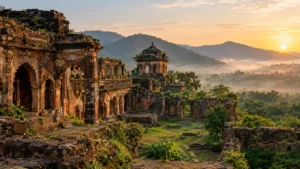
Ranpur Palace
The palace, locally called Ranpur Rajbati, is testament of the history and the events that happened throughout the time. There is not much life but a walk through the palace will make you understand the history of this place a little more. This palace was built sometime around the 14th century using local laterite and granite, it once housed a proper Darbar Hall, a private Rani Mahal, and separate guest quarters for visiting royalty. Today, most of that survives only as a trodden, abandoned, walls standing, arches carved but weathered. You can almost see the grandeur of the palace through certain photographs but unfortunately it wasn’t restored in that way. What was once testament of beauty and now lies secluded but this is what history is about.
There’s something genuinely striking about the setting too. The palace sits against the backdrop of Nayagarh’s green hills, and it is so peaceful and quiet. It was difficult to understand that this was once a functioning seat of power, complete with its own royal lineage running well past independence, the current Raja Saheb is reportedly the 182nd in the line, still holding the title even without the kingdom attached to it anymore. Visiting here isn’t about polished exhibits or guided tours. It’s closer to walking through a ruin that happens to still remember what it used to be.
Local Temples in Ranpur
Ranpur’s religious history is more than just royal history. It goes so much deeper than the royal kingdom and who ruled over it. The town’s Jagannath Temple was built by King Udhaba Singh sometime between 1324 and 1363 CE, making it one of the oldest Jagannath temples in Odisha, second only to the original at Puri. That’s also where the “second Shreekhetra” nickname comes from. This is not just a small shrine, it’s the second oldest Jagannath temple just after the main Jagannath temple that is in Puri.
There is one other temple nearby called Maninaga Temple, which is dedicated to Maa Maninaga. This is another site with deep roots in the town’s religious life. So many people visit these temples as pilgrims alongside the Jagannath Temple rather than as a separate detour. Both temples sit near the main market area of the town, close enough to the palace that seeing all three in a single visit is entirely realistic rather than something requiring a full day of driving between sites.
Travel Tips for Ranpur
Ranpur sits roughly 28 km from Nayagarh town, making it an easy addition to a broader day trip through the district rather than a standalone destination on its own. Since the palace interior is largely in ruins, there’s no formal ticketed entry or guided experience to plan around; it’s more of a walk-through-and-take-it-in kind of stop, best done unhurried rather than rushed.
Pairing Ranpur with nearby Khandapada Palace or Kuanria Dam makes for a fuller day out, since none of these sites individually demand a huge amount of time, but together they give a decent sense of Nayagarh’s layered history, royal, religious, and natural all within a fairly compact stretch of road. Mornings tend to be the more comfortable time to explore, especially if walking around the palace grounds is part of the plan, since there’s little shade once the sun is properly up. And if the temples are part of your visit, checking local timings ahead is worth doing, since smaller temple towns like this don’t always run on the same predictable schedule bigger pilgrimage sites do. This place is gorgeous and has so much historical impact that everyone should visit. It is truly one of the most underrated places in Odisha with so much religious and historical stuff to explore.
Frequently Asked Questions
Where is Ranpur located, and how far is it from Nayagarh town?
Ranpur is located in the district of Nayagarh, Odisha. It is approximately 28 km from Nayagarh town.
Is Ranpur Palace open for visitors?
Yes, the palace is open for visitors as it is mostly in ruins so you don’t have to buy tickets for entry or anything like that.
What makes Ranpur’s Jagannath Temple significant?
It is the second-oldest Jagannath temple in Odisha after Puri, which is also why Ranpur carries the nickname “dwitiya Shreekhetra” and this why it is quite significant.


