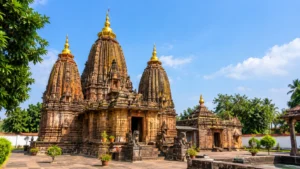
Before Puri welcomed Jagannath to their city, there was a forest deity on the Mahanadi’s banks. Nobody knew about this deity outside a small tribal community. That’s the story Kantilo tells. There was a quiet town in Nayagarh district, which was mostly famous for bell metal work and a temple that hadn’t stopped yet. It was yet to become Odisha’s biggest site ever.
History of Nilamadhav Temple
So famous about this Nilamadhav temple is that legend goes like this. A tribal king Vishwavasu used to worship Nilamadhav in secret, deep in the forest. At some point the deity vanished and turned up again near the sea at Puri, floating as a log. That log became Jagannath, Balabhadra, and Subhadra.
Now there is another version too, that involves the King Indradyumna, who dreamed of Nilamadhav and sent a priest in order to search through the forests of old Utkal so that he could track him down. Once Nilamadhav realized the king’s men were closing in, he slipped into the river rather than be found, and was found near Puri’s shore sometime later.
Even if you consider these stories as mythology and there’s still something solid factual history underneath it. Historical records show that Nilamadhava worship running for close to a thousand years, which was started around the 4th century AD, spread across four river valleys in Odisha, Mahanadi, Prachi, Baitarani, Rushikulya. Several Madhava shrines existed across these valleys once.
Kantilo’s is generally considered the most important of them, due to how old it is and for how directly it connects to the larger Jagannath story. Even now, inside the Puri temple complex itself, there’s a small Nilamadhav shrine sitting beside the Lakshmi temple, a low-key nod to where the tradition supposedly started.
Kantilo Town on the Mahanadi
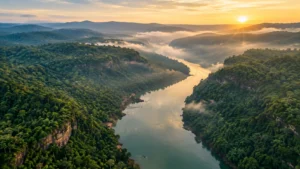
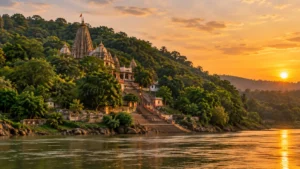
Kantilo isn’t a big place. There are a few thousand people, sitting on the Mahanadi’s right bank in Nayagarh district, under the Khandapada block. It is about 33 km from the district headquarters, approximately to 80 km from Bhubaneswar. Beyond the temple, the town has had its identity built around bell metal craftsmanship, a trade that’s kept a handful of local workshops going for generations. There is something about rivers. Boating is available if you want to see the temple and its hillside setting from the water, and sunset here ,the twin hills against the Mahanadi, comes up again and again in visitor accounts as the thing that actually stays with people.
Architecture of Kantilo Nilamadhab temple
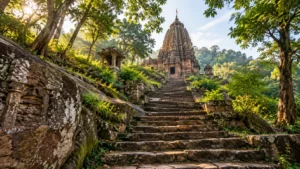
The main shrine is on Brahmadri, one of two hills here. Most locals also call the second one Himadri, sometimes Padmadri, depending on whom you are asking. It is surrounded by forest thick enough that the whole site still feels a bit wild, it is not like a manicured temple complexes elsewhere in the state. If you want to reach the main shrine you will have to climb approximately 36 steps, and they’re steep so please make sure you don’t rush as rushing on them isn’t a good idea. Once inside, alongside the Nilamadhav shrine itself, there’s also a shrine to Lord Siddheswar, a form of Shiva, a small detail that says something about how this site has held space for both Vaishnav and Shaiva worship without much friction. One thing almost every visitor mentions: water that continuously flows from the feet of the Nilamadhav idol, something close to a natural spring built right into the worship space.
Rituals & Festivals
Two events matter more than the rest here. Kartik Purnima brings the Sunabesh, the golden attire ceremony, also called Raj Rajeshwar Besh locally when the deity gets dressed in gold for a single day, and the crowd size shifts noticeably compared to any normal visit. Then there’s Bhauma Ekadasi, which isn’t a single day at all but stretches across a full month, treated by regular devotees as a serious devotional period rather than a one-off festival. Outside these two windows, worship carries on at a slower, quieter pace, part of why the temple still feels distinct from the bigger, busier pilgrimage circuits in Odisha.
Best Time to Visit
Winter November through February, is the easiest stretch to visit. Cooler weather makes the climb up more manageable and any time on the river more enjoyable. If the festival calendar matters to you, Kartik Purnima (usually October or November) is worth planning around specifically for the Sunabesh ceremony, though expect a much bigger crowd than usual. Monsoon has its own appeal, everything turns green, the Mahanadi runs fuller, good for photos, but the climb gets slippery, and boating might not be an option depending on water levels that week.
How to Reach Nilamadhav Temple?
Bhubaneswar is where most people should start, given it has both the nearest airport and better rail connections. From there it’s about 80 km to Kantilo by bus or taxi, usually under two hours depending on the roads. If you’re coming by train, get off at Bhubaneswar rather than the smaller Nayagarh Town station; bus and taxi options from Bhubaneswar are simply more frequent. A lot of people traveling by road also stop at Atri hot spring on the way, since it sits conveniently along the route and pairs naturally with a day trip out to Kantilo.
Frequently Asked Questions
Where is Nilamadhav Temple located?
The Nilamadhav Temple is located in Kantilo, at a town in Nayagarh district, Odisha. It is on the bank of the Mahanadi, which is approximately 80 km from Bhubaneswar.
What is the significance of Nilamadhav Temple?
The significance of Nilamadhav Temple is that it is considered the original form of Lord Jagannath. This temple ties directly into the legend of how the Jagannath idols came to Puri to be worshipped there
What are the temple’s opening and darshan timings?
The temple’s opening and darshan timings are basically the standard daily darshan hours apply, and are very similar to most Vaishnav shrines in Odisha. It is also worth checking locally, especially around festival dates when timings can shift.
How do I reach Nilamadhav Temple from Bhubaneswar?
You can reach Nilamadhav Temple from Bhubaneswar by road, bus or taxi, approximately 80 km, usually under two hours, with Atri hot spring as a convenient stop along the way.
What festivals are celebrated at Nilamadhav Temple?
The festivals which are celebrated at Nilamadhav Temple is the Sunabesh, or golden attire ceremony, on Kartik Purnima is the big one, along with a month-long Bhauma Ekadasi observance.
Is Kantilo worth visiting besides the temple?
Yes, the town’s bell metal craft tradition is worth a look, and boating on the Mahanadi gives you a different view of the temple and hills entirely.
What is the best time of year to visit Nilamadhav Temple?
November through February for comfortable weather, or time it around Kartik Purnima if you want to catch the Sunabesh festival, crowds and all.