
The winding, ancient street of Vishwanath Gali is buzzing with activity at 6 AM. As I maneuver my way through stalls overflowing with pink lotus flowers and metal water pots, I catch a whiff of ghee and cardamom in the air. I take a quick turn and enter a dimly lit stone courtyard where the sounds I heard a moment ago fade to the background, and the soft sound of the ladles hitting giant pots can be heard in the distance.
You are at the entrance of the Annapurna temple that is located a few steps from the golden towers of Lord Shiva’s main shrine. In the spiritual world of Kashi, if Lord Shiva is regarded to be the eternal king and guardian of souls, Goddess Annapurna is considered to be the loving mother of souls, whose role is to feed the souls in the holy city. Entering this holy temple represents the essence of visiting Varanasi.
Myth and Tradition: The Pact of Eternal Nutrition
In order to understand why this shrine occupies such a special place in the hearts of locals, one must explore the story behind its creation.
The Cosmic Story
According to ancient mythology, once upon a time Lord Shiva told the universe that the physical world was but an illusion called Maya — including food eaten by humans. Goddess Parvati, the incarnation of nature, made it a point to prove that the physical world can not simply be ignored. She left Earth, and the fields became barren, kitchens turned cold, and famine spread all over the globe.
Seeing all beings suffering, Shiva understood that enlightenment cannot be attained on an empty stomach. Parvati came back to Kashi Annapurna and created a sacred kitchen. Shiva himself went to her and came with a bowl, acknowledging the divine nature of food for the first time.
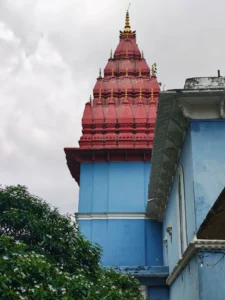
The Structure of the Historic Annapurna Mandir
The Shree Annapurna mandir was built in 1729 by the former Maratha general Peshwa Baji Rao I. Built in a typical Maratha architectural style, this temple has an enchanting courtyard with some intricately carved pillars, shaded balconies, and beautiful between other components. Strolling through these marble corridors is like being transported to the 18th century and being away from Delhi’s present-day hustle-bustle.
Feeling the Shrine: Successful Darshan and Mahaprasad
By exploring this holy complex, a traveler is likely to have memorable moments cherishing these two precious and deeply respected activities.
The Holy Idol and Annakut
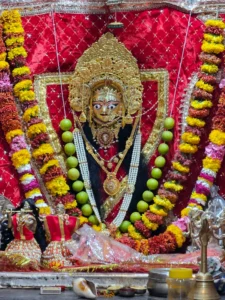
The holy effigy residing in the main temple is made out of smooth stone and shows the Goddess with a golden vessel containing porridge in one hand and a jeweled spoon in another preparing to feed Shiva. Nevertheless, if you visit the site during Dhanteras, you can get the unique opportunity. For four days only, the temple reveals the high sanctuary with its wonderful idol made of pure gold. Many pilgrims wait for hours in order to see this golden figure and get blessed coins from the priests.
Partaking in the Free Community Kitchen (Mahaprasad)
A visitor cannot leave the Annapurna temple Varanasi without enjoying its free meals. The temple has an expansive and pristine community kitchen (Annakshetra) where thousands of pilgrims, seers, and travelers every day enjoy free meals comprising only vegetarian dishes heated up for the occasion.
- Timing of the meal: Each day it starts at noon and lasts until 3 PM.
- How the process looks like: You will be seated on traditional mats inside a large dining hall. The volunteers will serve you food consisting of steaming rice, lentil soup, and curry made of vegetables, as well as bread made with flour prepared with eco-friendly plates.
- Cost of the meal: The meal is definitely free, but if someone wants to, he can donate ₹50 to ₹100 in donation boxes for keeping this process going.
Helpful Traveler’s Guide: Location and Arrangement
Because of the shrine’s location deep within the old town bazaar’s narrow lanes, it is necessary to plan your way in order to get to your destination without the need to stress out.
Getting There
The shrine is located in the downtown old town area next to Kashi Vishwanath Corridor Gate 1.
- Using an E-Rickshaw: An e-rickshaw can be taken from any location to Godowlia Crossing for a fare of ₹30 to ₹50.
- Walking: It should take no longer than 10 minutes to walk down Vishwanath Gali from Godowlia to the main osharihan entry gate at Annapurna Mandir Varanasi precinct.
Key Visitor Rules
- Security & Electronics: Unlike the nearby Golden Temple corridor, the security here is a bit more lenient. But taking photographs in the inner sanctum is strictly forbidden.
- Shoes: At the free shoe valet facility you need to leave your shoes and sandals before entering the courtyard.
- Most Convenient Visiting Time: The best time to visit is in the early morning hours between 06:30 AM and 08:30 AM for a cozy feeling.
Tulsi Manas Temple: Where Poetry and Marble Align
If you navigate to the university campus by walking straight for around 500 meters from the Durga Temple, you will find an atmospheric, shining white temple which at first glance seems to contrast significantly with the ancient temples of the old city, filled with the scent of burned incense. The Tulsi Manas Temple, constructed on the site where the saint-poet Goswami Tulsidas penned the famous Hindi version of the Ramayana, the Ramcharitmanas, in 1964.
The standout feature that travelers appreciate in this temple, made of white marble on two levels, are the interior walls composed of verses and sections of the Ramcharitmanas engraved in panels made of white marble. In the halls of the temple, where the air conditioning works wonders, you will come across scholars, who will seek out lines of local poetry with their fingers.
On the second floor of the temple, there is a wonderful example of folk culture: wooden puppets and scenes from the Ramayana that move. It is a wonderful stop in a hot summer in which admission is free.
What are the temple’s primary visiting hours?
The temple opens its doors at 4:00 AM, allowing for the morning worship (Aarti) to be conducted, and remains open until 1:30 PM. It is briefly closed in the early afternoon and reopens from 4:00 PM to 10:00 PM.
Are international travelers who are not Hindu allowed to eat at the Mahaprasad hall?
Yes. Visitors of any religious persuasion are allowed to dine. Standard procedures should be observed: shoes should be removed before entering the hall, and one should eat everything that is served on the plate made of leaves.
How far is the temple from the Varanasi railway station?
The temple is located approximately 5.5 kilometers in the southeast of the Varanasi Junction (Cantt Station). A trip by shared e-rickshaw usually takes about 20-25 minutes depending on traffic.


