
The moment I step onto the mystic Harishchandra Ghat, everything around me feels different. The air smells of burning wood and incense. I can almost hear the subtle sound of Ganga flowing beside me. People are walking past without speaking much, and so many families are gathered together. I can also hear the priests humming softly, and slow down for a minute to take in this moment.
I had already heard a great deal about Harishchandra Ghat in Varanasi before coming here, but honestly, standing here and looking with my own eyes is nothing compared to reading about it. The best part about these ghats is that it is so subtle, as there are no loud crowds or colourful celebrations, yet it truly feels larger than life. All I could feel was silence followed by prayers. Funeral pyres burning one after another in front of me made me feel different. A place that doesn’t try to impress anyone. It simply exists, carrying centuries of faith on its shoulders.
As I keep walking, notice stacks of firewood placed beside the cremation ground. I feel heaviness in my heart as a priest explaining rituals to a family. There is someone collecting water from the Ganga, and also sees the boat drifting slowly across the river. Life moves quietly around me while another family prepares to say their final goodbye. It feels emotional, very heavy, but strangely peaceful at the same time.
It feels strangely heavy to watch people bid their final goodbye. After spending a few more minutes here, I stopped thinking like a traveller; and simply witnessed everything around me in a different light. These ghats are so different from real life, as nobody seems in a hurry, and everyone knows the reason they are here. The sounds of temple bells mix with the chants as the smoke disappears into the morning sky from the pyres. It makes me realise why Kashi feels different from every other city I have visited.
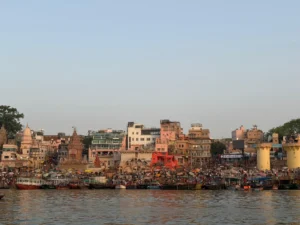
What’s the Harishchandra Ghat story?
While standing here, someone nearby begins telling me the infamous Harishchandra Ghat story. The story revolves around King Harishchandra, a ruler who chose truth even after he lost everything, his kingdom, his wealth and even his family. God made him go through a test where he lost his kingdom and money, and worked as somebody who collected fees before the cremation.
One day, his son dies of a snake bite, so his wife brings him to the cremation ground, and the king asks for the fee, and the wife doesn’t have any money. Since it was his wife, it was okay to let her pass through, but he didn’t; he refused, so then God was pleased as they passed the test. Later on, he gave the king’s son back, and his kingdom, wealth was restored as well.
Listening to the story while looking at the cremation ground somehow makes everything so real, like to be way more real than it is supposed to be. Almost as if history is such an essential part of these ghats.
Witnessing the Harishchandra Ghat electric cremation facility
As I continue walking, I notice another section of the ghat, it’s a bit less crowded, a little quieter. Someone nearby tells me this is the Harishchandra Ghat electric cremation facility. It feels different from the traditional cremation area, feels quite modern yet quite traditional in a way.
I watch various families entering the building while others continue with the traditional wooden pyres beside the river. I wondered how it felt bidding goodbye to your loved ones for the last time. On both sides, cremations were happening at the same time, and both were accepted with equal respect. One side was following centuries-old customs, the other offering a quicker and more environmentally friendly option. Looking at both together, I realise how Kashi has slowly changed with time without letting go of its essence and traditions.
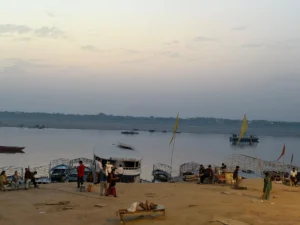
What is the atmosphere during sunrise and evening?
By now, the sun has climbed higher into the sky. The mist over the Ganga slowly disappears, and I can finally see the boats moving gently across the water. Priests continue their prayers as if time is a myth here. I found a quiet place to sit for a while. It was quite heavy to witness the pyres, so ended up sitting while watching the river, watching people come and go in peace.
I try to imagine how this place must look during sunrise. The first rays touch the Ganga. The chants begin before the city fully wakes up. Evening is quite different too, the temple bells echoing across the river also watched the lamps glowing in the distance as the smoke rose against the darkening sky. A view that probably stays with people for a while. For broader destination planning, our Koraput attractions helps place this stop within a Koraput itinerary.
What are the things I learned while visiting?
Before coming here, I had read that visitors should behave respectfully. Standing here, I totally understand why. Every family around me is going through one of the hardest moments of their lives. This isn’t a tourist attraction for them; it is a place of farewell.
So in order to respect what they were going through, I kept my phone away. I don’t take photographs or create a nuisance; instead, I simply observe from a distance without interrupting anyone. Somehow, that feels like the right thing to do. Some places are meant to be remembered through feelings, through memory rather than pictures.
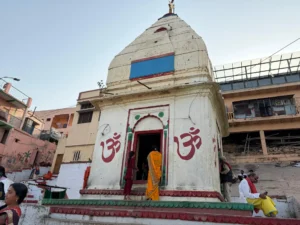
Exploring beyond Kashi Harishchandra Ghat
After spending enough time here, I slowly begin walking towards the neighbouring ghats. Leaving Kashi Harishchandra Ghat behind isn’t as easy as I expected. Every few steps reveal something new; it was also quite heavy to visit this place. I spotted a tiny temple hidden between old buildings, a chai stall with locals chatting.
The walk itself becomes part of the experience, as there was no fixed destination. Just narrow lanes, old stone steps and stories waiting around every corner. It reminds me that Varanasi isn’t only about famous landmarks; sometimes, the smallest moments become the most memorable.
Conclusion
As I turn back for one last look at Harishchandra Ghat, the smoke is still rising. The river is still flowing, the chants continue, just as they did when I first arrived. It suddenly feels like this place has been doing the same thing for centuries. Welcoming people in their final journey without ever stopping, people may come and go, but the ghat keeps on going.
The Harishchandra Ghat story no longer feels like something I simply read in a book. Standing here made it feel alive. This place values truth, sacrifice and duty, somehow blending into the atmosphere around me. Even the Harishchandra Ghat electric cremation facility reflects how old traditions and modern changes can exist together without losing their meaning.
I leave Harishchandra Ghat Varanasi with mixed emotions, a little heavy-hearted, a little grateful. It isn’t the kind of place you visit for beautiful photographs. It is the kind of place that quietly changes the way you look at life, and somehow, that stays with me long after I have left the banks of the Ganga.
Why is Harishchandra Ghat famous?
Harishchandra Ghat is famous as one of the oldest cremation ghats in Varanasi.
What is the Harishchandra Ghat story?
The Harishchandra Ghat story is about King Harishchandra, who sacrificed everything for its morale.
Does Harishchandra Ghat have an electric cremation facility?
Yes. Along with traditional wooden funeral pyres, the Harishchandra Ghat offers a modern cremation option.


