
Nilamadhav Temple rests on Brahmadri hill in Kantilo. That is in Nayagarh district, Odisha. People claim it is the original form of Lord Jagannath. Long before Puri got its famous temple, a forest deity stood on the Mahanadi’s banks. Only a small tribal community knew about it back then. It was concealed, quiet, just the trees and the river.
You will discover it in Kantilo. A town in Nayagarh district on the right bank of the Mahanadi. It is about 80 km from Bhubaneswar. Kantilo falls under the Khandapada block. The district headquarters, Nayagarh town, is roughly 33 km away. Not too far, but feels like another world.
It matters because it anchors the legend of how the Jagannath idols reached Puri. Kantilo is the most important surviving Madhava shrine. Ranked by age mostly. And by its direct link to the Jagannath story. Without this spot, the Puri story doesn’t really begin.
Nilamadhav is the forest deity. Legend says it reappeared at Puri as a floating log. That log became Jagannath, Balabhadra, and Subhadra. Puri’s temple complex still carries this origin. A small Nilamadhav shrine stands right beside the Lakshmi temple inside the main complex. Easy to miss if you aren’t looking for it.
The history mixes two legends with a documented worship tradition. It goes back to the 4th century AD. That’s a long time. Both legends place the deity in the forests of ancient Utkal before it appeared at Puri.
Vishwavasu was a tribal king. He worshipped Nilamadhav in secret deep in the forest. The deity then vanished. Turned up near the sea at Puri, floating as a log. That log became the three siblings. Simple story, but powerful.
King Indradyumna dreamed of Nilamadhav. He sent a priest to search the forests of old Utkal. Nilamadhav slipped into the river as the king’s men closed in. The deity was found near Puri’s shore some time later. Two versions. Same ending.
Records show worship running for close to a thousand years. Starting around the 4th century AD. The tradition spread across four river valleys. Several Madhava shrines once stood in them. Most are gone now.
The four river valleys are the Mahanadi, Prachi, Baitarani, and Rushikulya. Madhava shrines once existed across all four valleys. Kantilo is the one that lasted.
Kantilo ranks first among the Madhava shrines. Because of its age. And its direct connection to the larger Jagannath story. The others faded or got lost. This one stayed.
The Puri Nilamadhav shrine sits beside the Lakshmi temple. Inside the main complex. This low-key shrine marks where the tradition is believed to have started. People walk past it heading for the main darshan. Don’t be one of them. Stop a minute.
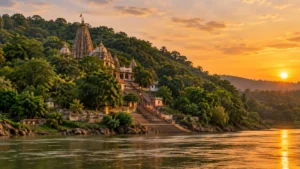
The main shrine stands on Brahmadri. One of two hills at Kantilo. Inside thick forest. The site feels wilder than the manicured temple complexes found elsewhere in Odisha. No polished marble floors here. Just stone, trees, and moss.

The temple occupies Brahmadri hill. Surrounded by dense forest on the Mahanadi’s bank. The forest cover gives the site a natural, unmanicured character. You hear birds more than bells sometimes. Monkeys watch you climb.
Brahmadri and Himadri are the two hills at Kantilo. Locals also call the second hill Padmadri. Depends on who you ask. Brahmadri holds the main shrine. Himadri is just there. Quiet.
Approximately 36 steps lead to the main shrine. The steps are steep. Climb at a steady pace rather than rushing. Your knees will thank you later. Especially coming down.
The temple houses the Nilamadhav idol. And a shrine to Lord Siddheswar, a form of Shiva. The two shrines show Vaishnav and Shaiva worship sharing one site without friction. No fights here. Just respect.
Lord Siddheswar is a form of Shiva worshipped in a shrine inside the Nilamadhav temple complex. Right next door basically. It’s a nice balance.
Water flows continuously from the feet of the Nilamadhav idol. Almost every visitor mentions it. It works like a natural spring built into the worship space. Cool, clear water. People cup their hands and drink. Prasad of a different kind.
Nilamadhav Temple follows the standard daily darshan hours common to Vaishnav shrines in Odisha. Confirm exact hours locally before you travel. Things change. Priests have their own schedule.
Darshan runs on the standard daily schedule of Odisha’s Vaishnav shrines. Local confirmation gives the exact opening and closing times. Usually early morning to noon. Then evening. But ask at the gate.
Timings shift around festival dates, especially Kartik Purnima. Check locally before a festival visit. Crowds mess up the routine. Gates open earlier. Close later.
Two observances matter most at Nilamadhav Temple. Sunabesh on Kartik Purnima. And the month-long Bhauma Ekadasi. Outside these windows, worship continues at a slower pace. Quiet. Personal.
Sunabesh is the golden attire ceremony. The deity is dressed in gold for a single day on Kartik Purnima. Locals also call it Raj Rajeshwar Besh. Crowds grow noticeably larger than on a normal day. Like, a lot larger. Parking becomes a nightmare.
Bhauma Ekadasi is a month-long devotional observance at Nilamadhav Temple. Not a single day. Regular devotees treat it as a serious devotional period rather than a one-off festival. You see the same faces every morning. Chanting. Reading.
Daily worship is slower and quieter than festival worship. This pace keeps Nilamadhav distinct from Odisha’s bigger, busier pilgrimage circuits. No queue management systems. No loudspeakers blaring bhajans at 5 AM. Just the priest, the bell, and the river sound.
Winter, from November through February, is the easiest season to visit. Cooler weather makes the climb and any river time more comfortable.
Winter is the best season for general visits. Cooler temperatures ease the steep climb to Brahmadri. And improve boating on the Mahanadi. You don’t sweat just standing still.
Visit during Kartik Purnima, usually in October or November, if you want to see the Sunabesh ceremony. Expect a much bigger crowd than usual. Like, really big. If you hate crowds, skip it. Come a week later.
Monsoon turns Kantilo green. Fills the Mahanadi. Suits photography. The climb gets slippery though. Watch your step. Boating depends on water levels that week. Sometimes too high, sometimes just right.
Bhubaneswar is the best starting point for Nilamadhav Temple. Because it has the nearest airport and the stronger rail connections. Kantilo is about 80 km from the city.
Take a bus or taxi from Bhubaneswar to Kantilo. A drive of about 80 km that usually takes under two hours. Road conditions affect the exact time. NH road is decent mostly. Last stretch gets narrow.
Buses and taxis run frequently from Bhubaneswar to Kantilo. Many road travelers stop at Atri hot spring. Which lies along the route. Good break. Dip your feet.
Get off at Bhubaneswar rather than the smaller Nayagarh Town station. Bhubaneswar offers more frequent bus and taxi connections onward to Kantilo. Nayagarh station is closer on map but transport from there is sparse. Don’t get stuck there.
Bhubaneswar has the nearest airport to Kantilo. From the airport, continue by road for about 80 km. Prepaid taxi counter is inside. Or book Ola/Uber.
Kantilo is about 33 km from Nayagarh town. The district headquarters. Easy drive if you are staying there.
Kantilo offers bell metal craftsmanship. Mahanadi boating. Sunset views. And it pairs with nearby stops such as Atri hot spring.
Kantilo is a small town of a few thousand people. On the Mahanadi’s right bank in Nayagarh district. The temple, the river, and a local craft tradition define it. That’s it. No malls. No multiplexes.
Kantilo is known for Nilamadhav Temple. And its bell metal craftsmanship. Nayagarh district is also known for bell metal work. You hear the clang clang before you see the shops.
Bell metal craft is the trade that has kept a handful of local workshops running in Kantilo for generations. The workshops are worth a visit. Watch them hammer hot metal into plates, bowls, lamps. Buy something. It’s heavy to carry but lasts forever.
Boating is available on the Mahanadi at Kantilo. It shows the temple and its hillside setting from the water. Availability depends on water levels. Ask the boatmen near the ghat. Negotiate price before sitting down.
The twin hills against the Mahanadi give Kantilo its best sunset view. Visitor accounts repeatedly name it as the experience that stays with people. Sit on the bank. Watch the light hit the water. Turn the hills gold. Then purple. Then dark.
Atri hot spring and Raghunathjew Temple are the two natural additions to a Kantilo trip. Both are in the surrounding region.
Atri hot spring sits along the Bhubaneswar-Kantilo route. Which makes it a convenient day-trip pairing with the temple. Sulphur smell hits you first. Water is hot. Good for skin they say. Changing rooms are basic.
Raghunathjew Temple at Odagaon is another quiet Vaishnav shrine in Nayagarh district. It is known for its Ramanavami Yatra. Less famous than Puri. But the vibe is similar. Old. Peaceful.
Nilamadhav Temple is the quiet, forest-set origin shrine. Puri hosts the larger Jagannath tradition and busier pilgrimage crowds. Puri’s complex itself contains a small Nilamadhav shrine beside the Lakshmi temple. So the circle completes. You start here. Or you end here. Doesn’t matter.
Yes. The bell metal craft tradition and Mahanadi boating give Kantilo value beyond the temple. Boating shows the temple and hills from a different angle. You see the back of the shrine. The forest canopy. It’s a different perspective.
The climb is short but steep. At approximately 36 steps. Winter makes it easier. Monsoon rain makes the steps slippery. Old people take it slow. Kids run up. You do you.


